Constraints Anaysis
Download this as a Jupyter notebook
This example notebook illustrates xLA features that are useful for problems with constraints.
Lets defined a constrained sphere problem, with the sphere function as the objective:
with the following constraints,
The sphere function is visualised below:
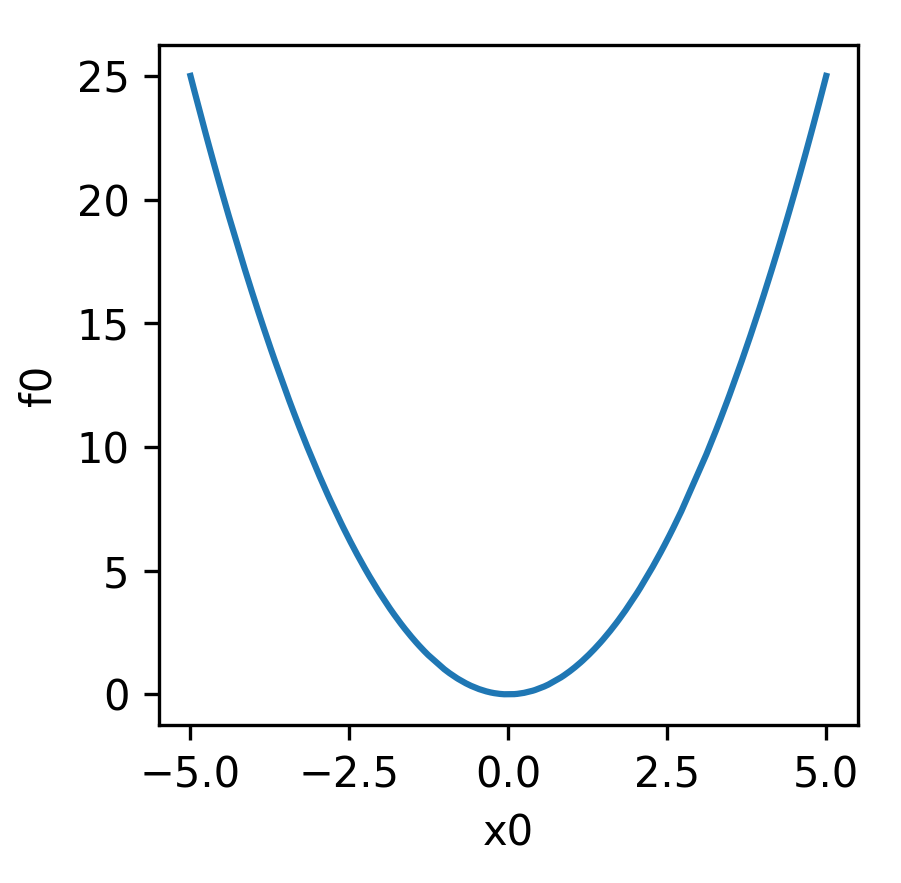
Equation (2) is visualised below:
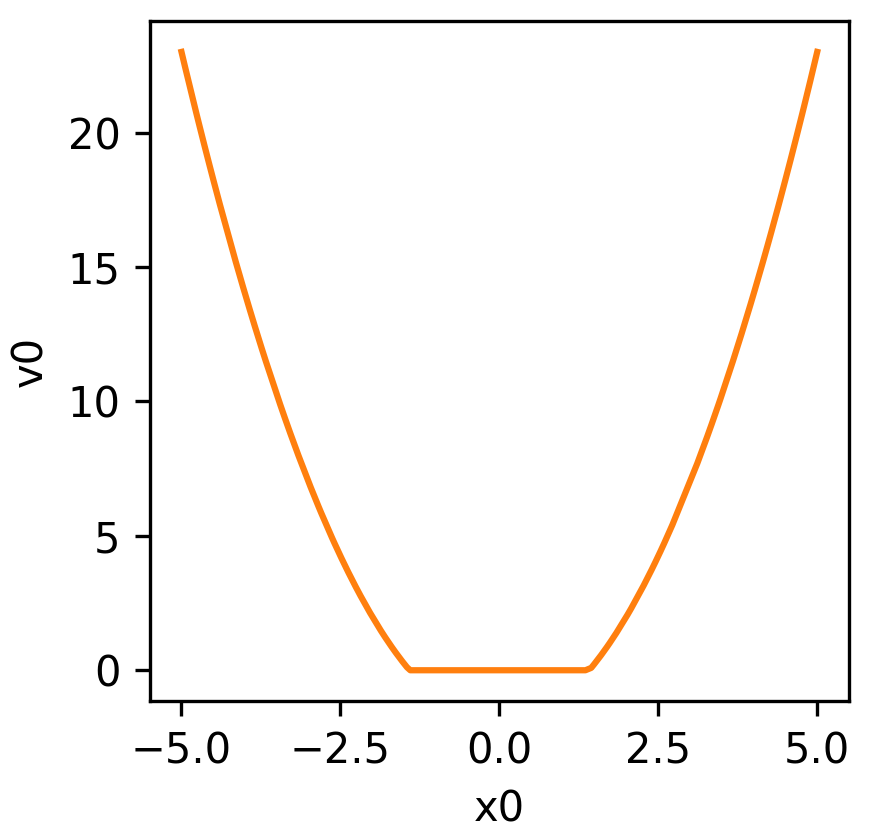
Equation (3) is visualised below:
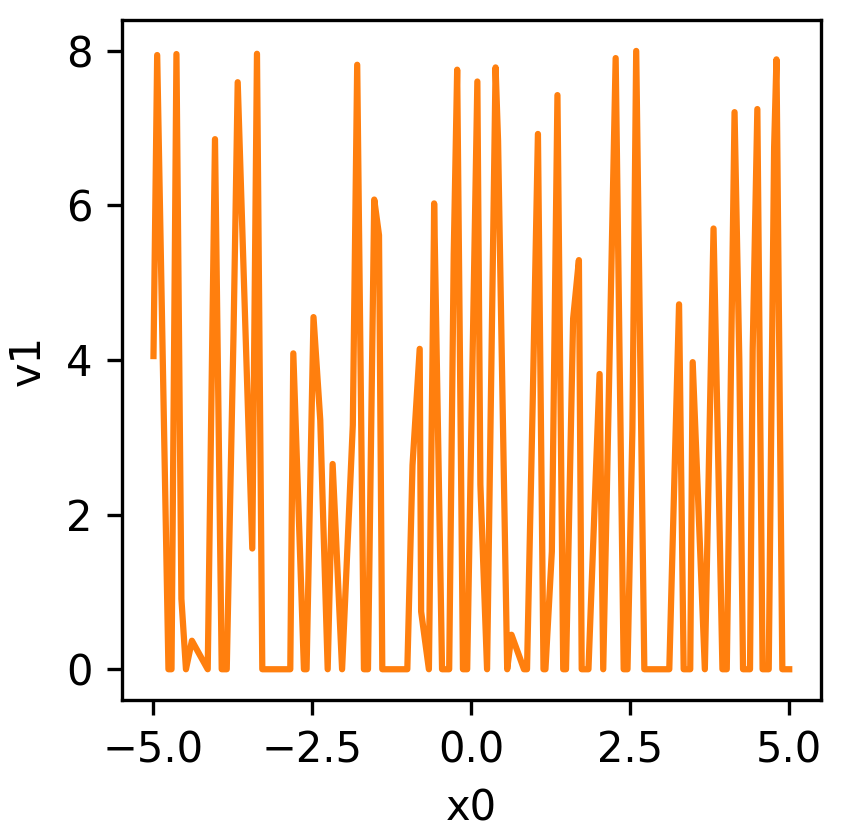
Let us define the problem as a sample
from pyxla import load_data
from pyxla.sampling import HilbertCurveSampler
import math

sphere_f = lambda x: x** 2

sphere_sample = {
    "name": "Sphere",
    "X": HilbertCurveSampler(sample_size=100, dim=1, l_bound=-5, u_bound=5),
    "F": sphere_f,
    "V": [lambda x: sphere_f(x) - 2, lambda x: 8 * math.sin(20 * x)]
}

load_data(sphere_sample) # loaded in-place
WARNING:root:The Hilbert curve with dimension 1 is just a number line. You are sampling around points on a number line.
Violation distribution (distr_V)
pyxla.distr_v() can show the distribution of violation values for the two constraints:
from pyxla import distr_v

feat, plot = distr_v(sphere_sample)
feat
{'v0_min': 0.0,
 'v0_max': 23.0,
 'v0_mean': 7.09599675993694,
 'v0_med': 4.823811008445192,
 'v0_q1': 0.0,
 'v0_q3': 13.025666005082412,
 'v0_sd': 7.375198758769731,
 'v0_skew': 0.6941768736271815,
 'v0_kurt': -0.8617340263008342,
 'v0_feas_rate': 0.27,
 'v1_min': 0.0,
 'v1_max': 7.999600456528671,
 'v1_mean': 2.4626471911853036,
 'v1_med': 0.0,
 'v1_q1': 0.0,
 'v1_q3': 5.506725209159034,
 'v1_sd': 3.0378721274130953,
 'v1_skew': 0.652795050784104,
 'v1_kurt': -1.2675436724160962,
 'v1_feas_rate': 0.52,
 'overall_feas_rate': 0.11}
Error in callback <function _draw_all_if_interactive at 0x79ab71c76e50> (for post_execute), with arguments args (),kwargs {}:
---------------------------------------------------------------------------
FileNotFoundError                         Traceback (most recent call last)
File /usr/local/lib/python3.14/site-packages/matplotlib/texmanager.py:258, in TexManager._run_checked_subprocess(cls, command, tex, cwd)
    257 try:
--> 258     report = subprocess.check_output(
    259         command, cwd=cwd if cwd is not None else cls._cache_dir,
    260         stderr=subprocess.STDOUT)
    261 except subprocess.CalledProcessError as exc:

File /usr/local/lib/python3.14/subprocess.py:473, in check_output(timeout, *popenargs, **kwargs)
    471     kwargs['input'] = empty
--> 473 return run(*popenargs, stdout=PIPE, timeout=timeout, check=True,
    474            **kwargs).stdout

File /usr/local/lib/python3.14/subprocess.py:555, in run(input, capture_output, timeout, check, *popenargs, **kwargs)
    553     kwargs['stderr'] = PIPE
--> 555 with Popen(*popenargs, **kwargs) as process:
    556     try:

File /usr/local/lib/python3.14/subprocess.py:1039, in Popen.__init__(self, args, bufsize, executable, stdin, stdout, stderr, preexec_fn, close_fds, shell, cwd, env, universal_newlines, startupinfo, creationflags, restore_signals, start_new_session, pass_fds, user, group, extra_groups, encoding, errors, text, umask, pipesize, process_group)
   1036             self.stderr = io.TextIOWrapper(self.stderr,
   1037                     encoding=encoding, errors=errors)
-> 1039     self._execute_child(args, executable, preexec_fn, close_fds,
   1040                         pass_fds, cwd, env,
   1041                         startupinfo, creationflags, shell,
   1042                         p2cread, p2cwrite,
   1043                         c2pread, c2pwrite,
   1044                         errread, errwrite,
   1045                         restore_signals,
   1046                         gid, gids, uid, umask,
   1047                         start_new_session, process_group)
   1048 except:
   1049     # Cleanup if the child failed starting.

File /usr/local/lib/python3.14/subprocess.py:1990, in Popen._execute_child(self, args, executable, preexec_fn, close_fds, pass_fds, cwd, env, startupinfo, creationflags, shell, p2cread, p2cwrite, c2pread, c2pwrite, errread, errwrite, restore_signals, gid, gids, uid, umask, start_new_session, process_group)
   1989 if err_filename is not None:
-> 1990     raise child_exception_type(errno_num, err_msg, err_filename)
   1991 else:

FileNotFoundError: [Errno 2] No such file or directory: 'latex'

The above exception was the direct cause of the following exception:

RuntimeError                              Traceback (most recent call last)
File /usr/local/lib/python3.14/site-packages/matplotlib/pyplot.py:300, in _draw_all_if_interactive()
    298 def _draw_all_if_interactive() -> None:
    299     if matplotlib.is_interactive():
--> 300         draw_all()

File /usr/local/lib/python3.14/site-packages/matplotlib/_pylab_helpers.py:133, in Gcf.draw_all(cls, force)
    131 for manager in cls.get_all_fig_managers():
    132     if force or manager.canvas.figure.stale:
--> 133         manager.canvas.draw_idle()

File /usr/local/lib/python3.14/site-packages/matplotlib/backend_bases.py:1989, in FigureCanvasBase.draw_idle(self, *args, **kwargs)
   1987 if not self._is_idle_drawing:
   1988     with self._idle_draw_cntx():
-> 1989         self.draw(*args, **kwargs)

File /usr/local/lib/python3.14/site-packages/matplotlib/backends/backend_agg.py:438, in FigureCanvasAgg.draw(self)
    435 # Acquire a lock on the shared font cache.
    436 with (self.toolbar._wait_cursor_for_draw_cm() if self.toolbar
    437       else nullcontext()):
--> 438     self.figure.draw(self.renderer)
    439     # A GUI class may be need to update a window using this draw, so
    440     # don't forget to call the superclass.
    441     super().draw()

File /usr/local/lib/python3.14/site-packages/matplotlib/artist.py:94, in _finalize_rasterization.<locals>.draw_wrapper(artist, renderer, *args, **kwargs)
     92 @wraps(draw)
     93 def draw_wrapper(artist, renderer, *args, **kwargs):
---> 94     result = draw(artist, renderer, *args, **kwargs)
     95     if renderer._rasterizing:
     96         renderer.stop_rasterizing()

File /usr/local/lib/python3.14/site-packages/matplotlib/artist.py:71, in allow_rasterization.<locals>.draw_wrapper(artist, renderer)
     68     if artist.get_agg_filter() is not None:
     69         renderer.start_filter()
---> 71     return draw(artist, renderer)
     72 finally:
     73     if artist.get_agg_filter() is not None:

File /usr/local/lib/python3.14/site-packages/matplotlib/figure.py:3276, in Figure.draw(self, renderer)
   3274 if self.axes and self.get_layout_engine() is not None:
   3275     try:
-> 3276         self.get_layout_engine().execute(self)
   3277     except ValueError:
   3278         pass

File /usr/local/lib/python3.14/site-packages/matplotlib/layout_engine.py:278, in ConstrainedLayoutEngine.execute(self, fig)
    275 w_pad = self._params['w_pad'] / width
    276 h_pad = self._params['h_pad'] / height
--> 278 return do_constrained_layout(fig, w_pad=w_pad, h_pad=h_pad,
    279                              wspace=self._params['wspace'],
    280                              hspace=self._params['hspace'],
    281                              rect=self._params['rect'],
    282                              compress=self._compress)

File /usr/local/lib/python3.14/site-packages/matplotlib/_constrained_layout.py:116, in do_constrained_layout(fig, h_pad, w_pad, hspace, wspace, rect, compress)
    106     return
    108 for _ in range(2):
    109     # do the algorithm twice.  This has to be done because decorations
    110     # change size after the first re-position (i.e. x/yticklabels get
   (...)    114     # make margins for all the Axes and subfigures in the
    115     # figure.  Add margins for colorbars...
--> 116     make_layout_margins(layoutgrids, fig, renderer, h_pad=h_pad,
    117                         w_pad=w_pad, hspace=hspace, wspace=wspace)
    118     make_margin_suptitles(layoutgrids, fig, renderer, h_pad=h_pad,
    119                           w_pad=w_pad)
    121     # if a layout is such that a columns (or rows) margin has no
    122     # constraints, we need to make all such instances in the grid
    123     # match in margin size.

File /usr/local/lib/python3.14/site-packages/matplotlib/_constrained_layout.py:389, in make_layout_margins(layoutgrids, fig, renderer, w_pad, h_pad, hspace, wspace)
    385     return
    387 margin = get_margin_from_padding(ax, w_pad=w_pad, h_pad=h_pad,
    388                                  hspace=hspace, wspace=wspace)
--> 389 pos, bbox = get_pos_and_bbox(ax, renderer)
    390 # the margin is the distance between the bounding box of the Axes
    391 # and its position (plus the padding from above)
    392 margin['left'] += pos.x0 - bbox.x0

File /usr/local/lib/python3.14/site-packages/matplotlib/_constrained_layout.py:637, in get_pos_and_bbox(ax, renderer)
    635 # pos is in panel co-ords, but we need in figure for the layout
    636 pos = pos.transformed(fig.transSubfigure - fig.transFigure)
--> 637 tightbbox = martist._get_tightbbox_for_layout_only(ax, renderer)
    638 if tightbbox is None:
    639     bbox = pos

File /usr/local/lib/python3.14/site-packages/matplotlib/artist.py:1485, in _get_tightbbox_for_layout_only(obj, *args, **kwargs)
   1479 """
   1480 Matplotlib's `.Axes.get_tightbbox` and `.Axis.get_tightbbox` support a
   1481 *for_layout_only* kwarg; this helper tries to use the kwarg but skips it
   1482 when encountering third-party subclasses that do not support it.
   1483 """
   1484 try:
-> 1485     return obj.get_tightbbox(*args, **{**kwargs, "for_layout_only": True})
   1486 except TypeError:
   1487     return obj.get_tightbbox(*args, **kwargs)

File /usr/local/lib/python3.14/site-packages/matplotlib/axes/_base.py:4758, in _AxesBase.get_tightbbox(self, renderer, call_axes_locator, bbox_extra_artists, for_layout_only)
   4756 if self.axison and axis.get_visible():
   4757     if for_layout_only:
-> 4758         ba = martist._get_tightbbox_for_layout_only(axis, renderer)
   4759     else:
   4760         ba = axis.get_tightbbox(renderer)

File /usr/local/lib/python3.14/site-packages/matplotlib/artist.py:1485, in _get_tightbbox_for_layout_only(obj, *args, **kwargs)
   1479 """
   1480 Matplotlib's `.Axes.get_tightbbox` and `.Axis.get_tightbbox` support a
   1481 *for_layout_only* kwarg; this helper tries to use the kwarg but skips it
   1482 when encountering third-party subclasses that do not support it.
   1483 """
   1484 try:
-> 1485     return obj.get_tightbbox(*args, **{**kwargs, "for_layout_only": True})
   1486 except TypeError:
   1487     return obj.get_tightbbox(*args, **kwargs)

File /usr/local/lib/python3.14/site-packages/matplotlib/axis.py:1427, in Axis.get_tightbbox(self, renderer, for_layout_only)
   1424     renderer = self.get_figure(root=True)._get_renderer()
   1425 ticks_to_draw = self._update_ticks()
-> 1427 self._update_label_position(renderer)
   1429 # go back to just this axis's tick labels
   1430 tlb1, tlb2 = self._get_ticklabel_bboxes(ticks_to_draw, renderer)

File /usr/local/lib/python3.14/site-packages/matplotlib/axis.py:2615, in XAxis._update_label_position(self, renderer)
   2611     return
   2613 # get bounding boxes for this axis and any siblings
   2614 # that have been set by `fig.align_xlabels()`
-> 2615 bboxes, bboxes2 = self._get_tick_boxes_siblings(renderer=renderer)
   2616 x, y = self.label.get_position()
   2618 if self.label_position == 'bottom':
   2619     # Union with extents of the bottom spine if present, of the axes otherwise.

File /usr/local/lib/python3.14/site-packages/matplotlib/axis.py:2403, in Axis._get_tick_boxes_siblings(self, renderer)
   2401 axis = ax._axis_map[name]
   2402 ticks_to_draw = axis._update_ticks()
-> 2403 tlb, tlb2 = axis._get_ticklabel_bboxes(ticks_to_draw, renderer)
   2404 bboxes.extend(tlb)
   2405 bboxes2.extend(tlb2)

File /usr/local/lib/python3.14/site-packages/matplotlib/axis.py:1404, in Axis._get_ticklabel_bboxes(self, ticks, renderer)
   1402 def _get_ticklabel_bboxes(self, ticks, renderer):
   1403     """Return lists of bboxes for ticks' label1's and label2's."""
-> 1404     return ([tick.label1.get_window_extent(renderer)
   1405              for tick in ticks
   1406              if tick.label1.get_visible() and tick.label1.get_in_layout()],
   1407             [tick.label2.get_window_extent(renderer)
   1408              for tick in ticks
   1409              if tick.label2.get_visible() and tick.label2.get_in_layout()])

File /usr/local/lib/python3.14/site-packages/matplotlib/text.py:1076, in Text.get_window_extent(self, renderer, dpi)
   1071     raise RuntimeError(
   1072         "Cannot get window extent of text w/o renderer. You likely "
   1073         "want to call 'figure.draw_without_rendering()' first.")
   1075 with cbook._setattr_cm(fig, dpi=dpi):
-> 1076     bbox, _, _ = self._get_layout(self._renderer)
   1077     x, y = self.get_unitless_position()
   1078     x, y = self.get_transform().transform((x, y))

File /usr/local/lib/python3.14/site-packages/matplotlib/text.py:465, in Text._get_layout(self, renderer)
    462             break
    463 if None in (min_ascent, min_descent):
    464     # Fallback to font measurement.
--> 465     _, h, min_descent = _get_text_metrics_with_cache(
    466         renderer, "lp", self._fontproperties,
    467         ismath="TeX" if self.get_usetex() else False,
    468         dpi=dpi)
    469     min_ascent = h - min_descent
    470     line_gap = 0

File /usr/local/lib/python3.14/site-packages/matplotlib/text.py:59, in _get_text_metrics_with_cache(renderer, text, fontprop, ismath, dpi)
     52 get_text_metrics = _get_text_metrics_function(renderer)
     53 # call the function to compute the metrics and return
     54 #
     55 # We pass a copy of the fontprop because FontProperties is both mutable and
     56 # has a `__hash__` that depends on that mutable state.  This is not ideal
     57 # as it means the hash of an object is not stable over time which leads to
     58 # very confusing behavior when used as keys in dictionaries or hashes.
---> 59 return get_text_metrics(text, fontprop.copy(), ismath, dpi)

File /usr/local/lib/python3.14/site-packages/matplotlib/text.py:125, in _get_text_metrics_function.<locals>._text_metrics(text, fontprop, ismath, dpi)
    120     raise RuntimeError(
    121         "Trying to get text metrics for a renderer that no longer exists.  "
    122         "This should never happen and is evidence of a bug elsewhere."
    123         )
    124 # do the actual method call we need and return the result
--> 125 return local_renderer.get_text_width_height_descent(text, fontprop, ismath)

File /usr/local/lib/python3.14/site-packages/matplotlib/backends/backend_agg.py:256, in RendererAgg.get_text_width_height_descent(self, s, prop, ismath)
    254 _api.check_in_list(["TeX", True, False], ismath=ismath)
    255 if ismath == "TeX":
--> 256     return super().get_text_width_height_descent(s, prop, ismath)
    258 if ismath:
    259     parse = self.mathtext_parser.parse(s, self.dpi, prop)

File /usr/local/lib/python3.14/site-packages/matplotlib/backend_bases.py:589, in RendererBase.get_text_width_height_descent(self, s, prop, ismath)
    585 fontsize = prop.get_size_in_points()
    587 if ismath == 'TeX':
    588     # todo: handle properties
--> 589     return self.get_texmanager().get_text_width_height_descent(
    590         s, fontsize, renderer=self)
    592 dpi = self.points_to_pixels(72)
    593 if ismath:

File /usr/local/lib/python3.14/site-packages/matplotlib/texmanager.py:369, in TexManager.get_text_width_height_descent(cls, tex, fontsize, renderer)
    367 if tex.strip() == '':
    368     return 0, 0, 0
--> 369 dvipath = cls.make_dvi(tex, fontsize)
    370 dpi_fraction = renderer.points_to_pixels(1.) if renderer else 1
    371 with dviread.Dvi(dvipath, 72 * dpi_fraction) as dvi:

File /usr/local/lib/python3.14/site-packages/matplotlib/texmanager.py:301, in TexManager.make_dvi(cls, tex, fontsize)
    298 with TemporaryDirectory(dir=dvipath.parent) as tmpdir:
    299     Path(tmpdir, "file.tex").write_text(
    300         cls._get_tex_source(tex, fontsize), encoding='utf-8')
--> 301     cls._run_checked_subprocess(
    302         ["latex", "-interaction=nonstopmode", "-halt-on-error",
    303          "-no-shell-escape", "file.tex"], tex, cwd=tmpdir)
    304     Path(tmpdir, "file.dvi").replace(dvipath)
    305     # Also move the tex source to the main cache directory, but
    306     # only for backcompat.

File /usr/local/lib/python3.14/site-packages/matplotlib/texmanager.py:274, in TexManager._run_checked_subprocess(cls, command, tex, cwd)
    262     raise RuntimeError(
    263         '{prog} was not able to process the following string:\n'
    264         '{tex!r}\n\n'
   (...)    271             exc=exc.output.decode('utf-8', 'backslashreplace'))
    272         ) from None
    273 except (FileNotFoundError, OSError) as exc:
--> 274     raise RuntimeError(
    275         f'Failed to process string with tex because {command[0]} '
    276         'could not be found') from exc
    277 _log.debug(report)
    278 return report

RuntimeError: Failed to process string with tex because latex could not be found
---------------------------------------------------------------------------
FileNotFoundError                         Traceback (most recent call last)
File /usr/local/lib/python3.14/site-packages/matplotlib/texmanager.py:258, in TexManager._run_checked_subprocess(cls, command, tex, cwd)
    257 try:
--> 258     report = subprocess.check_output(
    259         command, cwd=cwd if cwd is not None else cls._cache_dir,
    260         stderr=subprocess.STDOUT)
    261 except subprocess.CalledProcessError as exc:

File /usr/local/lib/python3.14/subprocess.py:473, in check_output(timeout, *popenargs, **kwargs)
    471     kwargs['input'] = empty
--> 473 return run(*popenargs, stdout=PIPE, timeout=timeout, check=True,
    474            **kwargs).stdout

File /usr/local/lib/python3.14/subprocess.py:555, in run(input, capture_output, timeout, check, *popenargs, **kwargs)
    553     kwargs['stderr'] = PIPE
--> 555 with Popen(*popenargs, **kwargs) as process:
    556     try:

File /usr/local/lib/python3.14/subprocess.py:1039, in Popen.__init__(self, args, bufsize, executable, stdin, stdout, stderr, preexec_fn, close_fds, shell, cwd, env, universal_newlines, startupinfo, creationflags, restore_signals, start_new_session, pass_fds, user, group, extra_groups, encoding, errors, text, umask, pipesize, process_group)
   1036             self.stderr = io.TextIOWrapper(self.stderr,
   1037                     encoding=encoding, errors=errors)
-> 1039     self._execute_child(args, executable, preexec_fn, close_fds,
   1040                         pass_fds, cwd, env,
   1041                         startupinfo, creationflags, shell,
   1042                         p2cread, p2cwrite,
   1043                         c2pread, c2pwrite,
   1044                         errread, errwrite,
   1045                         restore_signals,
   1046                         gid, gids, uid, umask,
   1047                         start_new_session, process_group)
   1048 except:
   1049     # Cleanup if the child failed starting.

File /usr/local/lib/python3.14/subprocess.py:1990, in Popen._execute_child(self, args, executable, preexec_fn, close_fds, pass_fds, cwd, env, startupinfo, creationflags, shell, p2cread, p2cwrite, c2pread, c2pwrite, errread, errwrite, restore_signals, gid, gids, uid, umask, start_new_session, process_group)
   1989 if err_filename is not None:
-> 1990     raise child_exception_type(errno_num, err_msg, err_filename)
   1991 else:

FileNotFoundError: [Errno 2] No such file or directory: 'latex'

The above exception was the direct cause of the following exception:

RuntimeError                              Traceback (most recent call last)
File /usr/local/lib/python3.14/site-packages/matplotlib/backend_bases.py:2257, in FigureCanvasBase.print_figure(self, filename, dpi, facecolor, edgecolor, orientation, format, bbox_inches, pad_inches, bbox_extra_artists, backend, **kwargs)
   2254     # we do this instead of `self.figure.draw_without_rendering`
   2255     # so that we can inject the orientation
   2256     with getattr(renderer, "_draw_disabled", nullcontext)():
-> 2257         self.figure.draw(renderer)
   2258 else:
   2259     renderer = None

File /usr/local/lib/python3.14/site-packages/matplotlib/artist.py:94, in _finalize_rasterization.<locals>.draw_wrapper(artist, renderer, *args, **kwargs)
     92 @wraps(draw)
     93 def draw_wrapper(artist, renderer, *args, **kwargs):
---> 94     result = draw(artist, renderer, *args, **kwargs)
     95     if renderer._rasterizing:
     96         renderer.stop_rasterizing()

File /usr/local/lib/python3.14/site-packages/matplotlib/artist.py:71, in allow_rasterization.<locals>.draw_wrapper(artist, renderer)
     68     if artist.get_agg_filter() is not None:
     69         renderer.start_filter()
---> 71     return draw(artist, renderer)
     72 finally:
     73     if artist.get_agg_filter() is not None:

File /usr/local/lib/python3.14/site-packages/matplotlib/figure.py:3276, in Figure.draw(self, renderer)
   3274 if self.axes and self.get_layout_engine() is not None:
   3275     try:
-> 3276         self.get_layout_engine().execute(self)
   3277     except ValueError:
   3278         pass

File /usr/local/lib/python3.14/site-packages/matplotlib/layout_engine.py:278, in ConstrainedLayoutEngine.execute(self, fig)
    275 w_pad = self._params['w_pad'] / width
    276 h_pad = self._params['h_pad'] / height
--> 278 return do_constrained_layout(fig, w_pad=w_pad, h_pad=h_pad,
    279                              wspace=self._params['wspace'],
    280                              hspace=self._params['hspace'],
    281                              rect=self._params['rect'],
    282                              compress=self._compress)

File /usr/local/lib/python3.14/site-packages/matplotlib/_constrained_layout.py:116, in do_constrained_layout(fig, h_pad, w_pad, hspace, wspace, rect, compress)
    106     return
    108 for _ in range(2):
    109     # do the algorithm twice.  This has to be done because decorations
    110     # change size after the first re-position (i.e. x/yticklabels get
   (...)    114     # make margins for all the Axes and subfigures in the
    115     # figure.  Add margins for colorbars...
--> 116     make_layout_margins(layoutgrids, fig, renderer, h_pad=h_pad,
    117                         w_pad=w_pad, hspace=hspace, wspace=wspace)
    118     make_margin_suptitles(layoutgrids, fig, renderer, h_pad=h_pad,
    119                           w_pad=w_pad)
    121     # if a layout is such that a columns (or rows) margin has no
    122     # constraints, we need to make all such instances in the grid
    123     # match in margin size.

File /usr/local/lib/python3.14/site-packages/matplotlib/_constrained_layout.py:389, in make_layout_margins(layoutgrids, fig, renderer, w_pad, h_pad, hspace, wspace)
    385     return
    387 margin = get_margin_from_padding(ax, w_pad=w_pad, h_pad=h_pad,
    388                                  hspace=hspace, wspace=wspace)
--> 389 pos, bbox = get_pos_and_bbox(ax, renderer)
    390 # the margin is the distance between the bounding box of the Axes
    391 # and its position (plus the padding from above)
    392 margin['left'] += pos.x0 - bbox.x0

File /usr/local/lib/python3.14/site-packages/matplotlib/_constrained_layout.py:637, in get_pos_and_bbox(ax, renderer)
    635 # pos is in panel co-ords, but we need in figure for the layout
    636 pos = pos.transformed(fig.transSubfigure - fig.transFigure)
--> 637 tightbbox = martist._get_tightbbox_for_layout_only(ax, renderer)
    638 if tightbbox is None:
    639     bbox = pos

File /usr/local/lib/python3.14/site-packages/matplotlib/artist.py:1485, in _get_tightbbox_for_layout_only(obj, *args, **kwargs)
   1479 """
   1480 Matplotlib's `.Axes.get_tightbbox` and `.Axis.get_tightbbox` support a
   1481 *for_layout_only* kwarg; this helper tries to use the kwarg but skips it
   1482 when encountering third-party subclasses that do not support it.
   1483 """
   1484 try:
-> 1485     return obj.get_tightbbox(*args, **{**kwargs, "for_layout_only": True})
   1486 except TypeError:
   1487     return obj.get_tightbbox(*args, **kwargs)

File /usr/local/lib/python3.14/site-packages/matplotlib/axes/_base.py:4758, in _AxesBase.get_tightbbox(self, renderer, call_axes_locator, bbox_extra_artists, for_layout_only)
   4756 if self.axison and axis.get_visible():
   4757     if for_layout_only:
-> 4758         ba = martist._get_tightbbox_for_layout_only(axis, renderer)
   4759     else:
   4760         ba = axis.get_tightbbox(renderer)

File /usr/local/lib/python3.14/site-packages/matplotlib/artist.py:1485, in _get_tightbbox_for_layout_only(obj, *args, **kwargs)
   1479 """
   1480 Matplotlib's `.Axes.get_tightbbox` and `.Axis.get_tightbbox` support a
   1481 *for_layout_only* kwarg; this helper tries to use the kwarg but skips it
   1482 when encountering third-party subclasses that do not support it.
   1483 """
   1484 try:
-> 1485     return obj.get_tightbbox(*args, **{**kwargs, "for_layout_only": True})
   1486 except TypeError:
   1487     return obj.get_tightbbox(*args, **kwargs)

File /usr/local/lib/python3.14/site-packages/matplotlib/axis.py:1427, in Axis.get_tightbbox(self, renderer, for_layout_only)
   1424     renderer = self.get_figure(root=True)._get_renderer()
   1425 ticks_to_draw = self._update_ticks()
-> 1427 self._update_label_position(renderer)
   1429 # go back to just this axis's tick labels
   1430 tlb1, tlb2 = self._get_ticklabel_bboxes(ticks_to_draw, renderer)

File /usr/local/lib/python3.14/site-packages/matplotlib/axis.py:2615, in XAxis._update_label_position(self, renderer)
   2611     return
   2613 # get bounding boxes for this axis and any siblings
   2614 # that have been set by `fig.align_xlabels()`
-> 2615 bboxes, bboxes2 = self._get_tick_boxes_siblings(renderer=renderer)
   2616 x, y = self.label.get_position()
   2618 if self.label_position == 'bottom':
   2619     # Union with extents of the bottom spine if present, of the axes otherwise.

File /usr/local/lib/python3.14/site-packages/matplotlib/axis.py:2403, in Axis._get_tick_boxes_siblings(self, renderer)
   2401 axis = ax._axis_map[name]
   2402 ticks_to_draw = axis._update_ticks()
-> 2403 tlb, tlb2 = axis._get_ticklabel_bboxes(ticks_to_draw, renderer)
   2404 bboxes.extend(tlb)
   2405 bboxes2.extend(tlb2)

File /usr/local/lib/python3.14/site-packages/matplotlib/axis.py:1404, in Axis._get_ticklabel_bboxes(self, ticks, renderer)
   1402 def _get_ticklabel_bboxes(self, ticks, renderer):
   1403     """Return lists of bboxes for ticks' label1's and label2's."""
-> 1404     return ([tick.label1.get_window_extent(renderer)
   1405              for tick in ticks
   1406              if tick.label1.get_visible() and tick.label1.get_in_layout()],
   1407             [tick.label2.get_window_extent(renderer)
   1408              for tick in ticks
   1409              if tick.label2.get_visible() and tick.label2.get_in_layout()])

File /usr/local/lib/python3.14/site-packages/matplotlib/text.py:1076, in Text.get_window_extent(self, renderer, dpi)
   1071     raise RuntimeError(
   1072         "Cannot get window extent of text w/o renderer. You likely "
   1073         "want to call 'figure.draw_without_rendering()' first.")
   1075 with cbook._setattr_cm(fig, dpi=dpi):
-> 1076     bbox, _, _ = self._get_layout(self._renderer)
   1077     x, y = self.get_unitless_position()
   1078     x, y = self.get_transform().transform((x, y))

File /usr/local/lib/python3.14/site-packages/matplotlib/text.py:465, in Text._get_layout(self, renderer)
    462             break
    463 if None in (min_ascent, min_descent):
    464     # Fallback to font measurement.
--> 465     _, h, min_descent = _get_text_metrics_with_cache(
    466         renderer, "lp", self._fontproperties,
    467         ismath="TeX" if self.get_usetex() else False,
    468         dpi=dpi)
    469     min_ascent = h - min_descent
    470     line_gap = 0

File /usr/local/lib/python3.14/site-packages/matplotlib/text.py:59, in _get_text_metrics_with_cache(renderer, text, fontprop, ismath, dpi)
     52 get_text_metrics = _get_text_metrics_function(renderer)
     53 # call the function to compute the metrics and return
     54 #
     55 # We pass a copy of the fontprop because FontProperties is both mutable and
     56 # has a `__hash__` that depends on that mutable state.  This is not ideal
     57 # as it means the hash of an object is not stable over time which leads to
     58 # very confusing behavior when used as keys in dictionaries or hashes.
---> 59 return get_text_metrics(text, fontprop.copy(), ismath, dpi)

File /usr/local/lib/python3.14/site-packages/matplotlib/text.py:125, in _get_text_metrics_function.<locals>._text_metrics(text, fontprop, ismath, dpi)
    120     raise RuntimeError(
    121         "Trying to get text metrics for a renderer that no longer exists.  "
    122         "This should never happen and is evidence of a bug elsewhere."
    123         )
    124 # do the actual method call we need and return the result
--> 125 return local_renderer.get_text_width_height_descent(text, fontprop, ismath)

File /usr/local/lib/python3.14/site-packages/matplotlib/backends/backend_agg.py:256, in RendererAgg.get_text_width_height_descent(self, s, prop, ismath)
    254 _api.check_in_list(["TeX", True, False], ismath=ismath)
    255 if ismath == "TeX":
--> 256     return super().get_text_width_height_descent(s, prop, ismath)
    258 if ismath:
    259     parse = self.mathtext_parser.parse(s, self.dpi, prop)

File /usr/local/lib/python3.14/site-packages/matplotlib/backend_bases.py:589, in RendererBase.get_text_width_height_descent(self, s, prop, ismath)
    585 fontsize = prop.get_size_in_points()
    587 if ismath == 'TeX':
    588     # todo: handle properties
--> 589     return self.get_texmanager().get_text_width_height_descent(
    590         s, fontsize, renderer=self)
    592 dpi = self.points_to_pixels(72)
    593 if ismath:

File /usr/local/lib/python3.14/site-packages/matplotlib/texmanager.py:369, in TexManager.get_text_width_height_descent(cls, tex, fontsize, renderer)
    367 if tex.strip() == '':
    368     return 0, 0, 0
--> 369 dvipath = cls.make_dvi(tex, fontsize)
    370 dpi_fraction = renderer.points_to_pixels(1.) if renderer else 1
    371 with dviread.Dvi(dvipath, 72 * dpi_fraction) as dvi:

File /usr/local/lib/python3.14/site-packages/matplotlib/texmanager.py:301, in TexManager.make_dvi(cls, tex, fontsize)
    298 with TemporaryDirectory(dir=dvipath.parent) as tmpdir:
    299     Path(tmpdir, "file.tex").write_text(
    300         cls._get_tex_source(tex, fontsize), encoding='utf-8')
--> 301     cls._run_checked_subprocess(
    302         ["latex", "-interaction=nonstopmode", "-halt-on-error",
    303          "-no-shell-escape", "file.tex"], tex, cwd=tmpdir)
    304     Path(tmpdir, "file.dvi").replace(dvipath)
    305     # Also move the tex source to the main cache directory, but
    306     # only for backcompat.

File /usr/local/lib/python3.14/site-packages/matplotlib/texmanager.py:274, in TexManager._run_checked_subprocess(cls, command, tex, cwd)
    262     raise RuntimeError(
    263         '{prog} was not able to process the following string:\n'
    264         '{tex!r}\n\n'
   (...)    271             exc=exc.output.decode('utf-8', 'backslashreplace'))
    272         ) from None
    273 except (FileNotFoundError, OSError) as exc:
--> 274     raise RuntimeError(
    275         f'Failed to process string with tex because {command[0]} '
    276         'could not be found') from exc
    277 _log.debug(report)
    278 return report

RuntimeError: Failed to process string with tex because latex could not be found
<Figure size 900x600 with 6 Axes>
Pareto ranking distribution
from pyxla import distr_Par

distr_Par(sphere_sample)
({'paretoV_min': 0,
  'paretoV_max': 42,
  'paretoV_mean': 19.38,
  'paretoV_med': 16.5,
  'paretoV_q1': 7.25,
  'paretoV_q3': 32.0,
  'paretoV_sd': 13.767022520897868,
  'paretoV_skew': 0.12527279561209054,
  'paretoV_kurt': -1.3239951481202532,
  'paretoFV_min': 0,
  'paretoFV_max': 52,
  'paretoFV_mean': 26.69,
  'paretoFV_med': 26.5,
  'paretoFV_q1': 10.25,
  'paretoFV_q3': 42.0,
  'paretoFV_sd': 16.67011782450347,
  'paretoFV_skew': -0.044434741083962156,
  'paretoFV_kurt': -1.3966984098870856},
 <Figure size 600x300 with 2 Axes>)
Error in callback <function _draw_all_if_interactive at 0x79ab71c76e50> (for post_execute), with arguments args (),kwargs {}:
---------------------------------------------------------------------------
FileNotFoundError                         Traceback (most recent call last)
File /usr/local/lib/python3.14/site-packages/matplotlib/texmanager.py:258, in TexManager._run_checked_subprocess(cls, command, tex, cwd)
    257 try:
--> 258     report = subprocess.check_output(
    259         command, cwd=cwd if cwd is not None else cls._cache_dir,
    260         stderr=subprocess.STDOUT)
    261 except subprocess.CalledProcessError as exc:

File /usr/local/lib/python3.14/subprocess.py:473, in check_output(timeout, *popenargs, **kwargs)
    471     kwargs['input'] = empty
--> 473 return run(*popenargs, stdout=PIPE, timeout=timeout, check=True,
    474            **kwargs).stdout

File /usr/local/lib/python3.14/subprocess.py:555, in run(input, capture_output, timeout, check, *popenargs, **kwargs)
    553     kwargs['stderr'] = PIPE
--> 555 with Popen(*popenargs, **kwargs) as process:
    556     try:

File /usr/local/lib/python3.14/subprocess.py:1039, in Popen.__init__(self, args, bufsize, executable, stdin, stdout, stderr, preexec_fn, close_fds, shell, cwd, env, universal_newlines, startupinfo, creationflags, restore_signals, start_new_session, pass_fds, user, group, extra_groups, encoding, errors, text, umask, pipesize, process_group)
   1036             self.stderr = io.TextIOWrapper(self.stderr,
   1037                     encoding=encoding, errors=errors)
-> 1039     self._execute_child(args, executable, preexec_fn, close_fds,
   1040                         pass_fds, cwd, env,
   1041                         startupinfo, creationflags, shell,
   1042                         p2cread, p2cwrite,
   1043                         c2pread, c2pwrite,
   1044                         errread, errwrite,
   1045                         restore_signals,
   1046                         gid, gids, uid, umask,
   1047                         start_new_session, process_group)
   1048 except:
   1049     # Cleanup if the child failed starting.

File /usr/local/lib/python3.14/subprocess.py:1990, in Popen._execute_child(self, args, executable, preexec_fn, close_fds, pass_fds, cwd, env, startupinfo, creationflags, shell, p2cread, p2cwrite, c2pread, c2pwrite, errread, errwrite, restore_signals, gid, gids, uid, umask, start_new_session, process_group)
   1989 if err_filename is not None:
-> 1990     raise child_exception_type(errno_num, err_msg, err_filename)
   1991 else:

FileNotFoundError: [Errno 2] No such file or directory: 'latex'

The above exception was the direct cause of the following exception:

RuntimeError                              Traceback (most recent call last)
File /usr/local/lib/python3.14/site-packages/matplotlib/pyplot.py:300, in _draw_all_if_interactive()
    298 def _draw_all_if_interactive() -> None:
    299     if matplotlib.is_interactive():
--> 300         draw_all()

File /usr/local/lib/python3.14/site-packages/matplotlib/_pylab_helpers.py:133, in Gcf.draw_all(cls, force)
    131 for manager in cls.get_all_fig_managers():
    132     if force or manager.canvas.figure.stale:
--> 133         manager.canvas.draw_idle()

File /usr/local/lib/python3.14/site-packages/matplotlib/backend_bases.py:1989, in FigureCanvasBase.draw_idle(self, *args, **kwargs)
   1987 if not self._is_idle_drawing:
   1988     with self._idle_draw_cntx():
-> 1989         self.draw(*args, **kwargs)

File /usr/local/lib/python3.14/site-packages/matplotlib/backends/backend_agg.py:438, in FigureCanvasAgg.draw(self)
    435 # Acquire a lock on the shared font cache.
    436 with (self.toolbar._wait_cursor_for_draw_cm() if self.toolbar
    437       else nullcontext()):
--> 438     self.figure.draw(self.renderer)
    439     # A GUI class may be need to update a window using this draw, so
    440     # don't forget to call the superclass.
    441     super().draw()

File /usr/local/lib/python3.14/site-packages/matplotlib/artist.py:94, in _finalize_rasterization.<locals>.draw_wrapper(artist, renderer, *args, **kwargs)
     92 @wraps(draw)
     93 def draw_wrapper(artist, renderer, *args, **kwargs):
---> 94     result = draw(artist, renderer, *args, **kwargs)
     95     if renderer._rasterizing:
     96         renderer.stop_rasterizing()

File /usr/local/lib/python3.14/site-packages/matplotlib/artist.py:71, in allow_rasterization.<locals>.draw_wrapper(artist, renderer)
     68     if artist.get_agg_filter() is not None:
     69         renderer.start_filter()
---> 71     return draw(artist, renderer)
     72 finally:
     73     if artist.get_agg_filter() is not None:

File /usr/local/lib/python3.14/site-packages/matplotlib/figure.py:3276, in Figure.draw(self, renderer)
   3274 if self.axes and self.get_layout_engine() is not None:
   3275     try:
-> 3276         self.get_layout_engine().execute(self)
   3277     except ValueError:
   3278         pass

File /usr/local/lib/python3.14/site-packages/matplotlib/layout_engine.py:278, in ConstrainedLayoutEngine.execute(self, fig)
    275 w_pad = self._params['w_pad'] / width
    276 h_pad = self._params['h_pad'] / height
--> 278 return do_constrained_layout(fig, w_pad=w_pad, h_pad=h_pad,
    279                              wspace=self._params['wspace'],
    280                              hspace=self._params['hspace'],
    281                              rect=self._params['rect'],
    282                              compress=self._compress)

File /usr/local/lib/python3.14/site-packages/matplotlib/_constrained_layout.py:116, in do_constrained_layout(fig, h_pad, w_pad, hspace, wspace, rect, compress)
    106     return
    108 for _ in range(2):
    109     # do the algorithm twice.  This has to be done because decorations
    110     # change size after the first re-position (i.e. x/yticklabels get
   (...)    114     # make margins for all the Axes and subfigures in the
    115     # figure.  Add margins for colorbars...
--> 116     make_layout_margins(layoutgrids, fig, renderer, h_pad=h_pad,
    117                         w_pad=w_pad, hspace=hspace, wspace=wspace)
    118     make_margin_suptitles(layoutgrids, fig, renderer, h_pad=h_pad,
    119                           w_pad=w_pad)
    121     # if a layout is such that a columns (or rows) margin has no
    122     # constraints, we need to make all such instances in the grid
    123     # match in margin size.

File /usr/local/lib/python3.14/site-packages/matplotlib/_constrained_layout.py:389, in make_layout_margins(layoutgrids, fig, renderer, w_pad, h_pad, hspace, wspace)
    385     return
    387 margin = get_margin_from_padding(ax, w_pad=w_pad, h_pad=h_pad,
    388                                  hspace=hspace, wspace=wspace)
--> 389 pos, bbox = get_pos_and_bbox(ax, renderer)
    390 # the margin is the distance between the bounding box of the Axes
    391 # and its position (plus the padding from above)
    392 margin['left'] += pos.x0 - bbox.x0

File /usr/local/lib/python3.14/site-packages/matplotlib/_constrained_layout.py:637, in get_pos_and_bbox(ax, renderer)
    635 # pos is in panel co-ords, but we need in figure for the layout
    636 pos = pos.transformed(fig.transSubfigure - fig.transFigure)
--> 637 tightbbox = martist._get_tightbbox_for_layout_only(ax, renderer)
    638 if tightbbox is None:
    639     bbox = pos

File /usr/local/lib/python3.14/site-packages/matplotlib/artist.py:1485, in _get_tightbbox_for_layout_only(obj, *args, **kwargs)
   1479 """
   1480 Matplotlib's `.Axes.get_tightbbox` and `.Axis.get_tightbbox` support a
   1481 *for_layout_only* kwarg; this helper tries to use the kwarg but skips it
   1482 when encountering third-party subclasses that do not support it.
   1483 """
   1484 try:
-> 1485     return obj.get_tightbbox(*args, **{**kwargs, "for_layout_only": True})
   1486 except TypeError:
   1487     return obj.get_tightbbox(*args, **kwargs)

File /usr/local/lib/python3.14/site-packages/matplotlib/axes/_base.py:4758, in _AxesBase.get_tightbbox(self, renderer, call_axes_locator, bbox_extra_artists, for_layout_only)
   4756 if self.axison and axis.get_visible():
   4757     if for_layout_only:
-> 4758         ba = martist._get_tightbbox_for_layout_only(axis, renderer)
   4759     else:
   4760         ba = axis.get_tightbbox(renderer)

File /usr/local/lib/python3.14/site-packages/matplotlib/artist.py:1485, in _get_tightbbox_for_layout_only(obj, *args, **kwargs)
   1479 """
   1480 Matplotlib's `.Axes.get_tightbbox` and `.Axis.get_tightbbox` support a
   1481 *for_layout_only* kwarg; this helper tries to use the kwarg but skips it
   1482 when encountering third-party subclasses that do not support it.
   1483 """
   1484 try:
-> 1485     return obj.get_tightbbox(*args, **{**kwargs, "for_layout_only": True})
   1486 except TypeError:
   1487     return obj.get_tightbbox(*args, **kwargs)

File /usr/local/lib/python3.14/site-packages/matplotlib/axis.py:1427, in Axis.get_tightbbox(self, renderer, for_layout_only)
   1424     renderer = self.get_figure(root=True)._get_renderer()
   1425 ticks_to_draw = self._update_ticks()
-> 1427 self._update_label_position(renderer)
   1429 # go back to just this axis's tick labels
   1430 tlb1, tlb2 = self._get_ticklabel_bboxes(ticks_to_draw, renderer)

File /usr/local/lib/python3.14/site-packages/matplotlib/axis.py:2615, in XAxis._update_label_position(self, renderer)
   2611     return
   2613 # get bounding boxes for this axis and any siblings
   2614 # that have been set by `fig.align_xlabels()`
-> 2615 bboxes, bboxes2 = self._get_tick_boxes_siblings(renderer=renderer)
   2616 x, y = self.label.get_position()
   2618 if self.label_position == 'bottom':
   2619     # Union with extents of the bottom spine if present, of the axes otherwise.

File /usr/local/lib/python3.14/site-packages/matplotlib/axis.py:2403, in Axis._get_tick_boxes_siblings(self, renderer)
   2401 axis = ax._axis_map[name]
   2402 ticks_to_draw = axis._update_ticks()
-> 2403 tlb, tlb2 = axis._get_ticklabel_bboxes(ticks_to_draw, renderer)
   2404 bboxes.extend(tlb)
   2405 bboxes2.extend(tlb2)

File /usr/local/lib/python3.14/site-packages/matplotlib/axis.py:1404, in Axis._get_ticklabel_bboxes(self, ticks, renderer)
   1402 def _get_ticklabel_bboxes(self, ticks, renderer):
   1403     """Return lists of bboxes for ticks' label1's and label2's."""
-> 1404     return ([tick.label1.get_window_extent(renderer)
   1405              for tick in ticks
   1406              if tick.label1.get_visible() and tick.label1.get_in_layout()],
   1407             [tick.label2.get_window_extent(renderer)
   1408              for tick in ticks
   1409              if tick.label2.get_visible() and tick.label2.get_in_layout()])

File /usr/local/lib/python3.14/site-packages/matplotlib/text.py:1076, in Text.get_window_extent(self, renderer, dpi)
   1071     raise RuntimeError(
   1072         "Cannot get window extent of text w/o renderer. You likely "
   1073         "want to call 'figure.draw_without_rendering()' first.")
   1075 with cbook._setattr_cm(fig, dpi=dpi):
-> 1076     bbox, _, _ = self._get_layout(self._renderer)
   1077     x, y = self.get_unitless_position()
   1078     x, y = self.get_transform().transform((x, y))

File /usr/local/lib/python3.14/site-packages/matplotlib/text.py:465, in Text._get_layout(self, renderer)
    462             break
    463 if None in (min_ascent, min_descent):
    464     # Fallback to font measurement.
--> 465     _, h, min_descent = _get_text_metrics_with_cache(
    466         renderer, "lp", self._fontproperties,
    467         ismath="TeX" if self.get_usetex() else False,
    468         dpi=dpi)
    469     min_ascent = h - min_descent
    470     line_gap = 0

File /usr/local/lib/python3.14/site-packages/matplotlib/text.py:59, in _get_text_metrics_with_cache(renderer, text, fontprop, ismath, dpi)
     52 get_text_metrics = _get_text_metrics_function(renderer)
     53 # call the function to compute the metrics and return
     54 #
     55 # We pass a copy of the fontprop because FontProperties is both mutable and
     56 # has a `__hash__` that depends on that mutable state.  This is not ideal
     57 # as it means the hash of an object is not stable over time which leads to
     58 # very confusing behavior when used as keys in dictionaries or hashes.
---> 59 return get_text_metrics(text, fontprop.copy(), ismath, dpi)

File /usr/local/lib/python3.14/site-packages/matplotlib/text.py:125, in _get_text_metrics_function.<locals>._text_metrics(text, fontprop, ismath, dpi)
    120     raise RuntimeError(
    121         "Trying to get text metrics for a renderer that no longer exists.  "
    122         "This should never happen and is evidence of a bug elsewhere."
    123         )
    124 # do the actual method call we need and return the result
--> 125 return local_renderer.get_text_width_height_descent(text, fontprop, ismath)

File /usr/local/lib/python3.14/site-packages/matplotlib/backends/backend_agg.py:256, in RendererAgg.get_text_width_height_descent(self, s, prop, ismath)
    254 _api.check_in_list(["TeX", True, False], ismath=ismath)
    255 if ismath == "TeX":
--> 256     return super().get_text_width_height_descent(s, prop, ismath)
    258 if ismath:
    259     parse = self.mathtext_parser.parse(s, self.dpi, prop)

File /usr/local/lib/python3.14/site-packages/matplotlib/backend_bases.py:589, in RendererBase.get_text_width_height_descent(self, s, prop, ismath)
    585 fontsize = prop.get_size_in_points()
    587 if ismath == 'TeX':
    588     # todo: handle properties
--> 589     return self.get_texmanager().get_text_width_height_descent(
    590         s, fontsize, renderer=self)
    592 dpi = self.points_to_pixels(72)
    593 if ismath:

File /usr/local/lib/python3.14/site-packages/matplotlib/texmanager.py:369, in TexManager.get_text_width_height_descent(cls, tex, fontsize, renderer)
    367 if tex.strip() == '':
    368     return 0, 0, 0
--> 369 dvipath = cls.make_dvi(tex, fontsize)
    370 dpi_fraction = renderer.points_to_pixels(1.) if renderer else 1
    371 with dviread.Dvi(dvipath, 72 * dpi_fraction) as dvi:

File /usr/local/lib/python3.14/site-packages/matplotlib/texmanager.py:301, in TexManager.make_dvi(cls, tex, fontsize)
    298 with TemporaryDirectory(dir=dvipath.parent) as tmpdir:
    299     Path(tmpdir, "file.tex").write_text(
    300         cls._get_tex_source(tex, fontsize), encoding='utf-8')
--> 301     cls._run_checked_subprocess(
    302         ["latex", "-interaction=nonstopmode", "-halt-on-error",
    303          "-no-shell-escape", "file.tex"], tex, cwd=tmpdir)
    304     Path(tmpdir, "file.dvi").replace(dvipath)
    305     # Also move the tex source to the main cache directory, but
    306     # only for backcompat.

File /usr/local/lib/python3.14/site-packages/matplotlib/texmanager.py:274, in TexManager._run_checked_subprocess(cls, command, tex, cwd)
    262     raise RuntimeError(
    263         '{prog} was not able to process the following string:\n'
    264         '{tex!r}\n\n'
   (...)    271             exc=exc.output.decode('utf-8', 'backslashreplace'))
    272         ) from None
    273 except (FileNotFoundError, OSError) as exc:
--> 274     raise RuntimeError(
    275         f'Failed to process string with tex because {command[0]} '
    276         'could not be found') from exc
    277 _log.debug(report)
    278 return report

RuntimeError: Failed to process string with tex because latex could not be found
---------------------------------------------------------------------------
FileNotFoundError                         Traceback (most recent call last)
File /usr/local/lib/python3.14/site-packages/matplotlib/texmanager.py:258, in TexManager._run_checked_subprocess(cls, command, tex, cwd)
    257 try:
--> 258     report = subprocess.check_output(
    259         command, cwd=cwd if cwd is not None else cls._cache_dir,
    260         stderr=subprocess.STDOUT)
    261 except subprocess.CalledProcessError as exc:

File /usr/local/lib/python3.14/subprocess.py:473, in check_output(timeout, *popenargs, **kwargs)
    471     kwargs['input'] = empty
--> 473 return run(*popenargs, stdout=PIPE, timeout=timeout, check=True,
    474            **kwargs).stdout

File /usr/local/lib/python3.14/subprocess.py:555, in run(input, capture_output, timeout, check, *popenargs, **kwargs)
    553     kwargs['stderr'] = PIPE
--> 555 with Popen(*popenargs, **kwargs) as process:
    556     try:

File /usr/local/lib/python3.14/subprocess.py:1039, in Popen.__init__(self, args, bufsize, executable, stdin, stdout, stderr, preexec_fn, close_fds, shell, cwd, env, universal_newlines, startupinfo, creationflags, restore_signals, start_new_session, pass_fds, user, group, extra_groups, encoding, errors, text, umask, pipesize, process_group)
   1036             self.stderr = io.TextIOWrapper(self.stderr,
   1037                     encoding=encoding, errors=errors)
-> 1039     self._execute_child(args, executable, preexec_fn, close_fds,
   1040                         pass_fds, cwd, env,
   1041                         startupinfo, creationflags, shell,
   1042                         p2cread, p2cwrite,
   1043                         c2pread, c2pwrite,
   1044                         errread, errwrite,
   1045                         restore_signals,
   1046                         gid, gids, uid, umask,
   1047                         start_new_session, process_group)
   1048 except:
   1049     # Cleanup if the child failed starting.

File /usr/local/lib/python3.14/subprocess.py:1990, in Popen._execute_child(self, args, executable, preexec_fn, close_fds, pass_fds, cwd, env, startupinfo, creationflags, shell, p2cread, p2cwrite, c2pread, c2pwrite, errread, errwrite, restore_signals, gid, gids, uid, umask, start_new_session, process_group)
   1989 if err_filename is not None:
-> 1990     raise child_exception_type(errno_num, err_msg, err_filename)
   1991 else:

FileNotFoundError: [Errno 2] No such file or directory: 'latex'

The above exception was the direct cause of the following exception:

RuntimeError                              Traceback (most recent call last)
File /usr/local/lib/python3.14/site-packages/matplotlib/backend_bases.py:2257, in FigureCanvasBase.print_figure(self, filename, dpi, facecolor, edgecolor, orientation, format, bbox_inches, pad_inches, bbox_extra_artists, backend, **kwargs)
   2254     # we do this instead of `self.figure.draw_without_rendering`
   2255     # so that we can inject the orientation
   2256     with getattr(renderer, "_draw_disabled", nullcontext)():
-> 2257         self.figure.draw(renderer)
   2258 else:
   2259     renderer = None

File /usr/local/lib/python3.14/site-packages/matplotlib/artist.py:94, in _finalize_rasterization.<locals>.draw_wrapper(artist, renderer, *args, **kwargs)
     92 @wraps(draw)
     93 def draw_wrapper(artist, renderer, *args, **kwargs):
---> 94     result = draw(artist, renderer, *args, **kwargs)
     95     if renderer._rasterizing:
     96         renderer.stop_rasterizing()

File /usr/local/lib/python3.14/site-packages/matplotlib/artist.py:71, in allow_rasterization.<locals>.draw_wrapper(artist, renderer)
     68     if artist.get_agg_filter() is not None:
     69         renderer.start_filter()
---> 71     return draw(artist, renderer)
     72 finally:
     73     if artist.get_agg_filter() is not None:

File /usr/local/lib/python3.14/site-packages/matplotlib/figure.py:3276, in Figure.draw(self, renderer)
   3274 if self.axes and self.get_layout_engine() is not None:
   3275     try:
-> 3276         self.get_layout_engine().execute(self)
   3277     except ValueError:
   3278         pass

File /usr/local/lib/python3.14/site-packages/matplotlib/layout_engine.py:278, in ConstrainedLayoutEngine.execute(self, fig)
    275 w_pad = self._params['w_pad'] / width
    276 h_pad = self._params['h_pad'] / height
--> 278 return do_constrained_layout(fig, w_pad=w_pad, h_pad=h_pad,
    279                              wspace=self._params['wspace'],
    280                              hspace=self._params['hspace'],
    281                              rect=self._params['rect'],
    282                              compress=self._compress)

File /usr/local/lib/python3.14/site-packages/matplotlib/_constrained_layout.py:116, in do_constrained_layout(fig, h_pad, w_pad, hspace, wspace, rect, compress)
    106     return
    108 for _ in range(2):
    109     # do the algorithm twice.  This has to be done because decorations
    110     # change size after the first re-position (i.e. x/yticklabels get
   (...)    114     # make margins for all the Axes and subfigures in the
    115     # figure.  Add margins for colorbars...
--> 116     make_layout_margins(layoutgrids, fig, renderer, h_pad=h_pad,
    117                         w_pad=w_pad, hspace=hspace, wspace=wspace)
    118     make_margin_suptitles(layoutgrids, fig, renderer, h_pad=h_pad,
    119                           w_pad=w_pad)
    121     # if a layout is such that a columns (or rows) margin has no
    122     # constraints, we need to make all such instances in the grid
    123     # match in margin size.

File /usr/local/lib/python3.14/site-packages/matplotlib/_constrained_layout.py:389, in make_layout_margins(layoutgrids, fig, renderer, w_pad, h_pad, hspace, wspace)
    385     return
    387 margin = get_margin_from_padding(ax, w_pad=w_pad, h_pad=h_pad,
    388                                  hspace=hspace, wspace=wspace)
--> 389 pos, bbox = get_pos_and_bbox(ax, renderer)
    390 # the margin is the distance between the bounding box of the Axes
    391 # and its position (plus the padding from above)
    392 margin['left'] += pos.x0 - bbox.x0

File /usr/local/lib/python3.14/site-packages/matplotlib/_constrained_layout.py:637, in get_pos_and_bbox(ax, renderer)
    635 # pos is in panel co-ords, but we need in figure for the layout
    636 pos = pos.transformed(fig.transSubfigure - fig.transFigure)
--> 637 tightbbox = martist._get_tightbbox_for_layout_only(ax, renderer)
    638 if tightbbox is None:
    639     bbox = pos

File /usr/local/lib/python3.14/site-packages/matplotlib/artist.py:1485, in _get_tightbbox_for_layout_only(obj, *args, **kwargs)
   1479 """
   1480 Matplotlib's `.Axes.get_tightbbox` and `.Axis.get_tightbbox` support a
   1481 *for_layout_only* kwarg; this helper tries to use the kwarg but skips it
   1482 when encountering third-party subclasses that do not support it.
   1483 """
   1484 try:
-> 1485     return obj.get_tightbbox(*args, **{**kwargs, "for_layout_only": True})
   1486 except TypeError:
   1487     return obj.get_tightbbox(*args, **kwargs)

File /usr/local/lib/python3.14/site-packages/matplotlib/axes/_base.py:4758, in _AxesBase.get_tightbbox(self, renderer, call_axes_locator, bbox_extra_artists, for_layout_only)
   4756 if self.axison and axis.get_visible():
   4757     if for_layout_only:
-> 4758         ba = martist._get_tightbbox_for_layout_only(axis, renderer)
   4759     else:
   4760         ba = axis.get_tightbbox(renderer)

File /usr/local/lib/python3.14/site-packages/matplotlib/artist.py:1485, in _get_tightbbox_for_layout_only(obj, *args, **kwargs)
   1479 """
   1480 Matplotlib's `.Axes.get_tightbbox` and `.Axis.get_tightbbox` support a
   1481 *for_layout_only* kwarg; this helper tries to use the kwarg but skips it
   1482 when encountering third-party subclasses that do not support it.
   1483 """
   1484 try:
-> 1485     return obj.get_tightbbox(*args, **{**kwargs, "for_layout_only": True})
   1486 except TypeError:
   1487     return obj.get_tightbbox(*args, **kwargs)

File /usr/local/lib/python3.14/site-packages/matplotlib/axis.py:1427, in Axis.get_tightbbox(self, renderer, for_layout_only)
   1424     renderer = self.get_figure(root=True)._get_renderer()
   1425 ticks_to_draw = self._update_ticks()
-> 1427 self._update_label_position(renderer)
   1429 # go back to just this axis's tick labels
   1430 tlb1, tlb2 = self._get_ticklabel_bboxes(ticks_to_draw, renderer)

File /usr/local/lib/python3.14/site-packages/matplotlib/axis.py:2615, in XAxis._update_label_position(self, renderer)
   2611     return
   2613 # get bounding boxes for this axis and any siblings
   2614 # that have been set by `fig.align_xlabels()`
-> 2615 bboxes, bboxes2 = self._get_tick_boxes_siblings(renderer=renderer)
   2616 x, y = self.label.get_position()
   2618 if self.label_position == 'bottom':
   2619     # Union with extents of the bottom spine if present, of the axes otherwise.

File /usr/local/lib/python3.14/site-packages/matplotlib/axis.py:2403, in Axis._get_tick_boxes_siblings(self, renderer)
   2401 axis = ax._axis_map[name]
   2402 ticks_to_draw = axis._update_ticks()
-> 2403 tlb, tlb2 = axis._get_ticklabel_bboxes(ticks_to_draw, renderer)
   2404 bboxes.extend(tlb)
   2405 bboxes2.extend(tlb2)

File /usr/local/lib/python3.14/site-packages/matplotlib/axis.py:1404, in Axis._get_ticklabel_bboxes(self, ticks, renderer)
   1402 def _get_ticklabel_bboxes(self, ticks, renderer):
   1403     """Return lists of bboxes for ticks' label1's and label2's."""
-> 1404     return ([tick.label1.get_window_extent(renderer)
   1405              for tick in ticks
   1406              if tick.label1.get_visible() and tick.label1.get_in_layout()],
   1407             [tick.label2.get_window_extent(renderer)
   1408              for tick in ticks
   1409              if tick.label2.get_visible() and tick.label2.get_in_layout()])

File /usr/local/lib/python3.14/site-packages/matplotlib/text.py:1076, in Text.get_window_extent(self, renderer, dpi)
   1071     raise RuntimeError(
   1072         "Cannot get window extent of text w/o renderer. You likely "
   1073         "want to call 'figure.draw_without_rendering()' first.")
   1075 with cbook._setattr_cm(fig, dpi=dpi):
-> 1076     bbox, _, _ = self._get_layout(self._renderer)
   1077     x, y = self.get_unitless_position()
   1078     x, y = self.get_transform().transform((x, y))

File /usr/local/lib/python3.14/site-packages/matplotlib/text.py:465, in Text._get_layout(self, renderer)
    462             break
    463 if None in (min_ascent, min_descent):
    464     # Fallback to font measurement.
--> 465     _, h, min_descent = _get_text_metrics_with_cache(
    466         renderer, "lp", self._fontproperties,
    467         ismath="TeX" if self.get_usetex() else False,
    468         dpi=dpi)
    469     min_ascent = h - min_descent
    470     line_gap = 0

File /usr/local/lib/python3.14/site-packages/matplotlib/text.py:59, in _get_text_metrics_with_cache(renderer, text, fontprop, ismath, dpi)
     52 get_text_metrics = _get_text_metrics_function(renderer)
     53 # call the function to compute the metrics and return
     54 #
     55 # We pass a copy of the fontprop because FontProperties is both mutable and
     56 # has a `__hash__` that depends on that mutable state.  This is not ideal
     57 # as it means the hash of an object is not stable over time which leads to
     58 # very confusing behavior when used as keys in dictionaries or hashes.
---> 59 return get_text_metrics(text, fontprop.copy(), ismath, dpi)

File /usr/local/lib/python3.14/site-packages/matplotlib/text.py:125, in _get_text_metrics_function.<locals>._text_metrics(text, fontprop, ismath, dpi)
    120     raise RuntimeError(
    121         "Trying to get text metrics for a renderer that no longer exists.  "
    122         "This should never happen and is evidence of a bug elsewhere."
    123         )
    124 # do the actual method call we need and return the result
--> 125 return local_renderer.get_text_width_height_descent(text, fontprop, ismath)

File /usr/local/lib/python3.14/site-packages/matplotlib/backends/backend_agg.py:256, in RendererAgg.get_text_width_height_descent(self, s, prop, ismath)
    254 _api.check_in_list(["TeX", True, False], ismath=ismath)
    255 if ismath == "TeX":
--> 256     return super().get_text_width_height_descent(s, prop, ismath)
    258 if ismath:
    259     parse = self.mathtext_parser.parse(s, self.dpi, prop)

File /usr/local/lib/python3.14/site-packages/matplotlib/backend_bases.py:589, in RendererBase.get_text_width_height_descent(self, s, prop, ismath)
    585 fontsize = prop.get_size_in_points()
    587 if ismath == 'TeX':
    588     # todo: handle properties
--> 589     return self.get_texmanager().get_text_width_height_descent(
    590         s, fontsize, renderer=self)
    592 dpi = self.points_to_pixels(72)
    593 if ismath:

File /usr/local/lib/python3.14/site-packages/matplotlib/texmanager.py:369, in TexManager.get_text_width_height_descent(cls, tex, fontsize, renderer)
    367 if tex.strip() == '':
    368     return 0, 0, 0
--> 369 dvipath = cls.make_dvi(tex, fontsize)
    370 dpi_fraction = renderer.points_to_pixels(1.) if renderer else 1
    371 with dviread.Dvi(dvipath, 72 * dpi_fraction) as dvi:

File /usr/local/lib/python3.14/site-packages/matplotlib/texmanager.py:301, in TexManager.make_dvi(cls, tex, fontsize)
    298 with TemporaryDirectory(dir=dvipath.parent) as tmpdir:
    299     Path(tmpdir, "file.tex").write_text(
    300         cls._get_tex_source(tex, fontsize), encoding='utf-8')
--> 301     cls._run_checked_subprocess(
    302         ["latex", "-interaction=nonstopmode", "-halt-on-error",
    303          "-no-shell-escape", "file.tex"], tex, cwd=tmpdir)
    304     Path(tmpdir, "file.dvi").replace(dvipath)
    305     # Also move the tex source to the main cache directory, but
    306     # only for backcompat.

File /usr/local/lib/python3.14/site-packages/matplotlib/texmanager.py:274, in TexManager._run_checked_subprocess(cls, command, tex, cwd)
    262     raise RuntimeError(
    263         '{prog} was not able to process the following string:\n'
    264         '{tex!r}\n\n'
   (...)    271             exc=exc.output.decode('utf-8', 'backslashreplace'))
    272         ) from None
    273 except (FileNotFoundError, OSError) as exc:
--> 274     raise RuntimeError(
    275         f'Failed to process string with tex because {command[0]} '
    276         'could not be found') from exc
    277 _log.debug(report)
    278 return report

RuntimeError: Failed to process string with tex because latex could not be found
<Figure size 600x300 with 2 Axes>
pyxla.distr_Par() gives an idea of how solutions rank against each other when the objective and the violation values are subjected to Pareto ranking.
Correlation among objective and violations and their ranks
from pyxla import corr, corr_ranks

corr, plot = corr(sphere_sample)
corr
/builds/aliefooghe/pyxla/src/pyxla/__init__.py:524: ConstantInputWarning: An input array is constant; the correlation coefficient is not defined.
  sp_corr_feas, _ = scipy.stats.spearmanr(FV_feas[x], FV_feas[y])
/builds/aliefooghe/pyxla/src/pyxla/__init__.py:524: ConstantInputWarning: An input array is constant; the correlation coefficient is not defined.
  sp_corr_feas, _ = scipy.stats.spearmanr(FV_feas[x], FV_feas[y])
/builds/aliefooghe/pyxla/src/pyxla/__init__.py:524: ConstantInputWarning: An input array is constant; the correlation coefficient is not defined.
  sp_corr_feas, _ = scipy.stats.spearmanr(FV_feas[x], FV_feas[y])
{'f0_v0_feasible': np.float64(nan),
 'f0_v0_infeasible': np.float64(0.9971016655579251),
 'f0_v1_feasible': np.float64(nan),
 'f0_v1_infeasible': np.float64(-0.08610832478152008),
 'v0_v1_feasible': np.float64(nan),
 'v0_v1_infeasible': np.float64(-0.08454319359436449)}
Error in callback <function _draw_all_if_interactive at 0x79ab71c76e50> (for post_execute), with arguments args (),kwargs {}:
---------------------------------------------------------------------------
FileNotFoundError                         Traceback (most recent call last)
File /usr/local/lib/python3.14/site-packages/matplotlib/texmanager.py:258, in TexManager._run_checked_subprocess(cls, command, tex, cwd)
    257 try:
--> 258     report = subprocess.check_output(
    259         command, cwd=cwd if cwd is not None else cls._cache_dir,
    260         stderr=subprocess.STDOUT)
    261 except subprocess.CalledProcessError as exc:

File /usr/local/lib/python3.14/subprocess.py:473, in check_output(timeout, *popenargs, **kwargs)
    471     kwargs['input'] = empty
--> 473 return run(*popenargs, stdout=PIPE, timeout=timeout, check=True,
    474            **kwargs).stdout

File /usr/local/lib/python3.14/subprocess.py:555, in run(input, capture_output, timeout, check, *popenargs, **kwargs)
    553     kwargs['stderr'] = PIPE
--> 555 with Popen(*popenargs, **kwargs) as process:
    556     try:

File /usr/local/lib/python3.14/subprocess.py:1039, in Popen.__init__(self, args, bufsize, executable, stdin, stdout, stderr, preexec_fn, close_fds, shell, cwd, env, universal_newlines, startupinfo, creationflags, restore_signals, start_new_session, pass_fds, user, group, extra_groups, encoding, errors, text, umask, pipesize, process_group)
   1036             self.stderr = io.TextIOWrapper(self.stderr,
   1037                     encoding=encoding, errors=errors)
-> 1039     self._execute_child(args, executable, preexec_fn, close_fds,
   1040                         pass_fds, cwd, env,
   1041                         startupinfo, creationflags, shell,
   1042                         p2cread, p2cwrite,
   1043                         c2pread, c2pwrite,
   1044                         errread, errwrite,
   1045                         restore_signals,
   1046                         gid, gids, uid, umask,
   1047                         start_new_session, process_group)
   1048 except:
   1049     # Cleanup if the child failed starting.

File /usr/local/lib/python3.14/subprocess.py:1990, in Popen._execute_child(self, args, executable, preexec_fn, close_fds, pass_fds, cwd, env, startupinfo, creationflags, shell, p2cread, p2cwrite, c2pread, c2pwrite, errread, errwrite, restore_signals, gid, gids, uid, umask, start_new_session, process_group)
   1989 if err_filename is not None:
-> 1990     raise child_exception_type(errno_num, err_msg, err_filename)
   1991 else:

FileNotFoundError: [Errno 2] No such file or directory: 'latex'

The above exception was the direct cause of the following exception:

RuntimeError                              Traceback (most recent call last)
File /usr/local/lib/python3.14/site-packages/matplotlib/pyplot.py:300, in _draw_all_if_interactive()
    298 def _draw_all_if_interactive() -> None:
    299     if matplotlib.is_interactive():
--> 300         draw_all()

File /usr/local/lib/python3.14/site-packages/matplotlib/_pylab_helpers.py:133, in Gcf.draw_all(cls, force)
    131 for manager in cls.get_all_fig_managers():
    132     if force or manager.canvas.figure.stale:
--> 133         manager.canvas.draw_idle()

File /usr/local/lib/python3.14/site-packages/matplotlib/backend_bases.py:1989, in FigureCanvasBase.draw_idle(self, *args, **kwargs)
   1987 if not self._is_idle_drawing:
   1988     with self._idle_draw_cntx():
-> 1989         self.draw(*args, **kwargs)

File /usr/local/lib/python3.14/site-packages/matplotlib/backends/backend_agg.py:438, in FigureCanvasAgg.draw(self)
    435 # Acquire a lock on the shared font cache.
    436 with (self.toolbar._wait_cursor_for_draw_cm() if self.toolbar
    437       else nullcontext()):
--> 438     self.figure.draw(self.renderer)
    439     # A GUI class may be need to update a window using this draw, so
    440     # don't forget to call the superclass.
    441     super().draw()

File /usr/local/lib/python3.14/site-packages/matplotlib/artist.py:94, in _finalize_rasterization.<locals>.draw_wrapper(artist, renderer, *args, **kwargs)
     92 @wraps(draw)
     93 def draw_wrapper(artist, renderer, *args, **kwargs):
---> 94     result = draw(artist, renderer, *args, **kwargs)
     95     if renderer._rasterizing:
     96         renderer.stop_rasterizing()

File /usr/local/lib/python3.14/site-packages/matplotlib/artist.py:71, in allow_rasterization.<locals>.draw_wrapper(artist, renderer)
     68     if artist.get_agg_filter() is not None:
     69         renderer.start_filter()
---> 71     return draw(artist, renderer)
     72 finally:
     73     if artist.get_agg_filter() is not None:

File /usr/local/lib/python3.14/site-packages/matplotlib/figure.py:3276, in Figure.draw(self, renderer)
   3274 if self.axes and self.get_layout_engine() is not None:
   3275     try:
-> 3276         self.get_layout_engine().execute(self)
   3277     except ValueError:
   3278         pass

File /usr/local/lib/python3.14/site-packages/matplotlib/layout_engine.py:278, in ConstrainedLayoutEngine.execute(self, fig)
    275 w_pad = self._params['w_pad'] / width
    276 h_pad = self._params['h_pad'] / height
--> 278 return do_constrained_layout(fig, w_pad=w_pad, h_pad=h_pad,
    279                              wspace=self._params['wspace'],
    280                              hspace=self._params['hspace'],
    281                              rect=self._params['rect'],
    282                              compress=self._compress)

File /usr/local/lib/python3.14/site-packages/matplotlib/_constrained_layout.py:116, in do_constrained_layout(fig, h_pad, w_pad, hspace, wspace, rect, compress)
    106     return
    108 for _ in range(2):
    109     # do the algorithm twice.  This has to be done because decorations
    110     # change size after the first re-position (i.e. x/yticklabels get
   (...)    114     # make margins for all the Axes and subfigures in the
    115     # figure.  Add margins for colorbars...
--> 116     make_layout_margins(layoutgrids, fig, renderer, h_pad=h_pad,
    117                         w_pad=w_pad, hspace=hspace, wspace=wspace)
    118     make_margin_suptitles(layoutgrids, fig, renderer, h_pad=h_pad,
    119                           w_pad=w_pad)
    121     # if a layout is such that a columns (or rows) margin has no
    122     # constraints, we need to make all such instances in the grid
    123     # match in margin size.

File /usr/local/lib/python3.14/site-packages/matplotlib/_constrained_layout.py:389, in make_layout_margins(layoutgrids, fig, renderer, w_pad, h_pad, hspace, wspace)
    385     return
    387 margin = get_margin_from_padding(ax, w_pad=w_pad, h_pad=h_pad,
    388                                  hspace=hspace, wspace=wspace)
--> 389 pos, bbox = get_pos_and_bbox(ax, renderer)
    390 # the margin is the distance between the bounding box of the Axes
    391 # and its position (plus the padding from above)
    392 margin['left'] += pos.x0 - bbox.x0

File /usr/local/lib/python3.14/site-packages/matplotlib/_constrained_layout.py:637, in get_pos_and_bbox(ax, renderer)
    635 # pos is in panel co-ords, but we need in figure for the layout
    636 pos = pos.transformed(fig.transSubfigure - fig.transFigure)
--> 637 tightbbox = martist._get_tightbbox_for_layout_only(ax, renderer)
    638 if tightbbox is None:
    639     bbox = pos

File /usr/local/lib/python3.14/site-packages/matplotlib/artist.py:1485, in _get_tightbbox_for_layout_only(obj, *args, **kwargs)
   1479 """
   1480 Matplotlib's `.Axes.get_tightbbox` and `.Axis.get_tightbbox` support a
   1481 *for_layout_only* kwarg; this helper tries to use the kwarg but skips it
   1482 when encountering third-party subclasses that do not support it.
   1483 """
   1484 try:
-> 1485     return obj.get_tightbbox(*args, **{**kwargs, "for_layout_only": True})
   1486 except TypeError:
   1487     return obj.get_tightbbox(*args, **kwargs)

File /usr/local/lib/python3.14/site-packages/matplotlib/axes/_base.py:4758, in _AxesBase.get_tightbbox(self, renderer, call_axes_locator, bbox_extra_artists, for_layout_only)
   4756 if self.axison and axis.get_visible():
   4757     if for_layout_only:
-> 4758         ba = martist._get_tightbbox_for_layout_only(axis, renderer)
   4759     else:
   4760         ba = axis.get_tightbbox(renderer)

File /usr/local/lib/python3.14/site-packages/matplotlib/artist.py:1485, in _get_tightbbox_for_layout_only(obj, *args, **kwargs)
   1479 """
   1480 Matplotlib's `.Axes.get_tightbbox` and `.Axis.get_tightbbox` support a
   1481 *for_layout_only* kwarg; this helper tries to use the kwarg but skips it
   1482 when encountering third-party subclasses that do not support it.
   1483 """
   1484 try:
-> 1485     return obj.get_tightbbox(*args, **{**kwargs, "for_layout_only": True})
   1486 except TypeError:
   1487     return obj.get_tightbbox(*args, **kwargs)

File /usr/local/lib/python3.14/site-packages/matplotlib/axis.py:1427, in Axis.get_tightbbox(self, renderer, for_layout_only)
   1424     renderer = self.get_figure(root=True)._get_renderer()
   1425 ticks_to_draw = self._update_ticks()
-> 1427 self._update_label_position(renderer)
   1429 # go back to just this axis's tick labels
   1430 tlb1, tlb2 = self._get_ticklabel_bboxes(ticks_to_draw, renderer)

File /usr/local/lib/python3.14/site-packages/matplotlib/axis.py:2615, in XAxis._update_label_position(self, renderer)
   2611     return
   2613 # get bounding boxes for this axis and any siblings
   2614 # that have been set by `fig.align_xlabels()`
-> 2615 bboxes, bboxes2 = self._get_tick_boxes_siblings(renderer=renderer)
   2616 x, y = self.label.get_position()
   2618 if self.label_position == 'bottom':
   2619     # Union with extents of the bottom spine if present, of the axes otherwise.

File /usr/local/lib/python3.14/site-packages/matplotlib/axis.py:2403, in Axis._get_tick_boxes_siblings(self, renderer)
   2401 axis = ax._axis_map[name]
   2402 ticks_to_draw = axis._update_ticks()
-> 2403 tlb, tlb2 = axis._get_ticklabel_bboxes(ticks_to_draw, renderer)
   2404 bboxes.extend(tlb)
   2405 bboxes2.extend(tlb2)

File /usr/local/lib/python3.14/site-packages/matplotlib/axis.py:1404, in Axis._get_ticklabel_bboxes(self, ticks, renderer)
   1402 def _get_ticklabel_bboxes(self, ticks, renderer):
   1403     """Return lists of bboxes for ticks' label1's and label2's."""
-> 1404     return ([tick.label1.get_window_extent(renderer)
   1405              for tick in ticks
   1406              if tick.label1.get_visible() and tick.label1.get_in_layout()],
   1407             [tick.label2.get_window_extent(renderer)
   1408              for tick in ticks
   1409              if tick.label2.get_visible() and tick.label2.get_in_layout()])

File /usr/local/lib/python3.14/site-packages/matplotlib/text.py:1076, in Text.get_window_extent(self, renderer, dpi)
   1071     raise RuntimeError(
   1072         "Cannot get window extent of text w/o renderer. You likely "
   1073         "want to call 'figure.draw_without_rendering()' first.")
   1075 with cbook._setattr_cm(fig, dpi=dpi):
-> 1076     bbox, _, _ = self._get_layout(self._renderer)
   1077     x, y = self.get_unitless_position()
   1078     x, y = self.get_transform().transform((x, y))

File /usr/local/lib/python3.14/site-packages/matplotlib/text.py:465, in Text._get_layout(self, renderer)
    462             break
    463 if None in (min_ascent, min_descent):
    464     # Fallback to font measurement.
--> 465     _, h, min_descent = _get_text_metrics_with_cache(
    466         renderer, "lp", self._fontproperties,
    467         ismath="TeX" if self.get_usetex() else False,
    468         dpi=dpi)
    469     min_ascent = h - min_descent
    470     line_gap = 0

File /usr/local/lib/python3.14/site-packages/matplotlib/text.py:59, in _get_text_metrics_with_cache(renderer, text, fontprop, ismath, dpi)
     52 get_text_metrics = _get_text_metrics_function(renderer)
     53 # call the function to compute the metrics and return
     54 #
     55 # We pass a copy of the fontprop because FontProperties is both mutable and
     56 # has a `__hash__` that depends on that mutable state.  This is not ideal
     57 # as it means the hash of an object is not stable over time which leads to
     58 # very confusing behavior when used as keys in dictionaries or hashes.
---> 59 return get_text_metrics(text, fontprop.copy(), ismath, dpi)

File /usr/local/lib/python3.14/site-packages/matplotlib/text.py:125, in _get_text_metrics_function.<locals>._text_metrics(text, fontprop, ismath, dpi)
    120     raise RuntimeError(
    121         "Trying to get text metrics for a renderer that no longer exists.  "
    122         "This should never happen and is evidence of a bug elsewhere."
    123         )
    124 # do the actual method call we need and return the result
--> 125 return local_renderer.get_text_width_height_descent(text, fontprop, ismath)

File /usr/local/lib/python3.14/site-packages/matplotlib/backends/backend_agg.py:256, in RendererAgg.get_text_width_height_descent(self, s, prop, ismath)
    254 _api.check_in_list(["TeX", True, False], ismath=ismath)
    255 if ismath == "TeX":
--> 256     return super().get_text_width_height_descent(s, prop, ismath)
    258 if ismath:
    259     parse = self.mathtext_parser.parse(s, self.dpi, prop)

File /usr/local/lib/python3.14/site-packages/matplotlib/backend_bases.py:589, in RendererBase.get_text_width_height_descent(self, s, prop, ismath)
    585 fontsize = prop.get_size_in_points()
    587 if ismath == 'TeX':
    588     # todo: handle properties
--> 589     return self.get_texmanager().get_text_width_height_descent(
    590         s, fontsize, renderer=self)
    592 dpi = self.points_to_pixels(72)
    593 if ismath:

File /usr/local/lib/python3.14/site-packages/matplotlib/texmanager.py:369, in TexManager.get_text_width_height_descent(cls, tex, fontsize, renderer)
    367 if tex.strip() == '':
    368     return 0, 0, 0
--> 369 dvipath = cls.make_dvi(tex, fontsize)
    370 dpi_fraction = renderer.points_to_pixels(1.) if renderer else 1
    371 with dviread.Dvi(dvipath, 72 * dpi_fraction) as dvi:

File /usr/local/lib/python3.14/site-packages/matplotlib/texmanager.py:301, in TexManager.make_dvi(cls, tex, fontsize)
    298 with TemporaryDirectory(dir=dvipath.parent) as tmpdir:
    299     Path(tmpdir, "file.tex").write_text(
    300         cls._get_tex_source(tex, fontsize), encoding='utf-8')
--> 301     cls._run_checked_subprocess(
    302         ["latex", "-interaction=nonstopmode", "-halt-on-error",
    303          "-no-shell-escape", "file.tex"], tex, cwd=tmpdir)
    304     Path(tmpdir, "file.dvi").replace(dvipath)
    305     # Also move the tex source to the main cache directory, but
    306     # only for backcompat.

File /usr/local/lib/python3.14/site-packages/matplotlib/texmanager.py:274, in TexManager._run_checked_subprocess(cls, command, tex, cwd)
    262     raise RuntimeError(
    263         '{prog} was not able to process the following string:\n'
    264         '{tex!r}\n\n'
   (...)    271             exc=exc.output.decode('utf-8', 'backslashreplace'))
    272         ) from None
    273 except (FileNotFoundError, OSError) as exc:
--> 274     raise RuntimeError(
    275         f'Failed to process string with tex because {command[0]} '
    276         'could not be found') from exc
    277 _log.debug(report)
    278 return report

RuntimeError: Failed to process string with tex because latex could not be found
---------------------------------------------------------------------------
FileNotFoundError                         Traceback (most recent call last)
File /usr/local/lib/python3.14/site-packages/matplotlib/texmanager.py:258, in TexManager._run_checked_subprocess(cls, command, tex, cwd)
    257 try:
--> 258     report = subprocess.check_output(
    259         command, cwd=cwd if cwd is not None else cls._cache_dir,
    260         stderr=subprocess.STDOUT)
    261 except subprocess.CalledProcessError as exc:

File /usr/local/lib/python3.14/subprocess.py:473, in check_output(timeout, *popenargs, **kwargs)
    471     kwargs['input'] = empty
--> 473 return run(*popenargs, stdout=PIPE, timeout=timeout, check=True,
    474            **kwargs).stdout

File /usr/local/lib/python3.14/subprocess.py:555, in run(input, capture_output, timeout, check, *popenargs, **kwargs)
    553     kwargs['stderr'] = PIPE
--> 555 with Popen(*popenargs, **kwargs) as process:
    556     try:

File /usr/local/lib/python3.14/subprocess.py:1039, in Popen.__init__(self, args, bufsize, executable, stdin, stdout, stderr, preexec_fn, close_fds, shell, cwd, env, universal_newlines, startupinfo, creationflags, restore_signals, start_new_session, pass_fds, user, group, extra_groups, encoding, errors, text, umask, pipesize, process_group)
   1036             self.stderr = io.TextIOWrapper(self.stderr,
   1037                     encoding=encoding, errors=errors)
-> 1039     self._execute_child(args, executable, preexec_fn, close_fds,
   1040                         pass_fds, cwd, env,
   1041                         startupinfo, creationflags, shell,
   1042                         p2cread, p2cwrite,
   1043                         c2pread, c2pwrite,
   1044                         errread, errwrite,
   1045                         restore_signals,
   1046                         gid, gids, uid, umask,
   1047                         start_new_session, process_group)
   1048 except:
   1049     # Cleanup if the child failed starting.

File /usr/local/lib/python3.14/subprocess.py:1990, in Popen._execute_child(self, args, executable, preexec_fn, close_fds, pass_fds, cwd, env, startupinfo, creationflags, shell, p2cread, p2cwrite, c2pread, c2pwrite, errread, errwrite, restore_signals, gid, gids, uid, umask, start_new_session, process_group)
   1989 if err_filename is not None:
-> 1990     raise child_exception_type(errno_num, err_msg, err_filename)
   1991 else:

FileNotFoundError: [Errno 2] No such file or directory: 'latex'

The above exception was the direct cause of the following exception:

RuntimeError                              Traceback (most recent call last)
File /usr/local/lib/python3.14/site-packages/matplotlib/backend_bases.py:2257, in FigureCanvasBase.print_figure(self, filename, dpi, facecolor, edgecolor, orientation, format, bbox_inches, pad_inches, bbox_extra_artists, backend, **kwargs)
   2254     # we do this instead of `self.figure.draw_without_rendering`
   2255     # so that we can inject the orientation
   2256     with getattr(renderer, "_draw_disabled", nullcontext)():
-> 2257         self.figure.draw(renderer)
   2258 else:
   2259     renderer = None

File /usr/local/lib/python3.14/site-packages/matplotlib/artist.py:94, in _finalize_rasterization.<locals>.draw_wrapper(artist, renderer, *args, **kwargs)
     92 @wraps(draw)
     93 def draw_wrapper(artist, renderer, *args, **kwargs):
---> 94     result = draw(artist, renderer, *args, **kwargs)
     95     if renderer._rasterizing:
     96         renderer.stop_rasterizing()

File /usr/local/lib/python3.14/site-packages/matplotlib/artist.py:71, in allow_rasterization.<locals>.draw_wrapper(artist, renderer)
     68     if artist.get_agg_filter() is not None:
     69         renderer.start_filter()
---> 71     return draw(artist, renderer)
     72 finally:
     73     if artist.get_agg_filter() is not None:

File /usr/local/lib/python3.14/site-packages/matplotlib/figure.py:3276, in Figure.draw(self, renderer)
   3274 if self.axes and self.get_layout_engine() is not None:
   3275     try:
-> 3276         self.get_layout_engine().execute(self)
   3277     except ValueError:
   3278         pass

File /usr/local/lib/python3.14/site-packages/matplotlib/layout_engine.py:278, in ConstrainedLayoutEngine.execute(self, fig)
    275 w_pad = self._params['w_pad'] / width
    276 h_pad = self._params['h_pad'] / height
--> 278 return do_constrained_layout(fig, w_pad=w_pad, h_pad=h_pad,
    279                              wspace=self._params['wspace'],
    280                              hspace=self._params['hspace'],
    281                              rect=self._params['rect'],
    282                              compress=self._compress)

File /usr/local/lib/python3.14/site-packages/matplotlib/_constrained_layout.py:116, in do_constrained_layout(fig, h_pad, w_pad, hspace, wspace, rect, compress)
    106     return
    108 for _ in range(2):
    109     # do the algorithm twice.  This has to be done because decorations
    110     # change size after the first re-position (i.e. x/yticklabels get
   (...)    114     # make margins for all the Axes and subfigures in the
    115     # figure.  Add margins for colorbars...
--> 116     make_layout_margins(layoutgrids, fig, renderer, h_pad=h_pad,
    117                         w_pad=w_pad, hspace=hspace, wspace=wspace)
    118     make_margin_suptitles(layoutgrids, fig, renderer, h_pad=h_pad,
    119                           w_pad=w_pad)
    121     # if a layout is such that a columns (or rows) margin has no
    122     # constraints, we need to make all such instances in the grid
    123     # match in margin size.

File /usr/local/lib/python3.14/site-packages/matplotlib/_constrained_layout.py:389, in make_layout_margins(layoutgrids, fig, renderer, w_pad, h_pad, hspace, wspace)
    385     return
    387 margin = get_margin_from_padding(ax, w_pad=w_pad, h_pad=h_pad,
    388                                  hspace=hspace, wspace=wspace)
--> 389 pos, bbox = get_pos_and_bbox(ax, renderer)
    390 # the margin is the distance between the bounding box of the Axes
    391 # and its position (plus the padding from above)
    392 margin['left'] += pos.x0 - bbox.x0

File /usr/local/lib/python3.14/site-packages/matplotlib/_constrained_layout.py:637, in get_pos_and_bbox(ax, renderer)
    635 # pos is in panel co-ords, but we need in figure for the layout
    636 pos = pos.transformed(fig.transSubfigure - fig.transFigure)
--> 637 tightbbox = martist._get_tightbbox_for_layout_only(ax, renderer)
    638 if tightbbox is None:
    639     bbox = pos

File /usr/local/lib/python3.14/site-packages/matplotlib/artist.py:1485, in _get_tightbbox_for_layout_only(obj, *args, **kwargs)
   1479 """
   1480 Matplotlib's `.Axes.get_tightbbox` and `.Axis.get_tightbbox` support a
   1481 *for_layout_only* kwarg; this helper tries to use the kwarg but skips it
   1482 when encountering third-party subclasses that do not support it.
   1483 """
   1484 try:
-> 1485     return obj.get_tightbbox(*args, **{**kwargs, "for_layout_only": True})
   1486 except TypeError:
   1487     return obj.get_tightbbox(*args, **kwargs)

File /usr/local/lib/python3.14/site-packages/matplotlib/axes/_base.py:4758, in _AxesBase.get_tightbbox(self, renderer, call_axes_locator, bbox_extra_artists, for_layout_only)
   4756 if self.axison and axis.get_visible():
   4757     if for_layout_only:
-> 4758         ba = martist._get_tightbbox_for_layout_only(axis, renderer)
   4759     else:
   4760         ba = axis.get_tightbbox(renderer)

File /usr/local/lib/python3.14/site-packages/matplotlib/artist.py:1485, in _get_tightbbox_for_layout_only(obj, *args, **kwargs)
   1479 """
   1480 Matplotlib's `.Axes.get_tightbbox` and `.Axis.get_tightbbox` support a
   1481 *for_layout_only* kwarg; this helper tries to use the kwarg but skips it
   1482 when encountering third-party subclasses that do not support it.
   1483 """
   1484 try:
-> 1485     return obj.get_tightbbox(*args, **{**kwargs, "for_layout_only": True})
   1486 except TypeError:
   1487     return obj.get_tightbbox(*args, **kwargs)

File /usr/local/lib/python3.14/site-packages/matplotlib/axis.py:1427, in Axis.get_tightbbox(self, renderer, for_layout_only)
   1424     renderer = self.get_figure(root=True)._get_renderer()
   1425 ticks_to_draw = self._update_ticks()
-> 1427 self._update_label_position(renderer)
   1429 # go back to just this axis's tick labels
   1430 tlb1, tlb2 = self._get_ticklabel_bboxes(ticks_to_draw, renderer)

File /usr/local/lib/python3.14/site-packages/matplotlib/axis.py:2615, in XAxis._update_label_position(self, renderer)
   2611     return
   2613 # get bounding boxes for this axis and any siblings
   2614 # that have been set by `fig.align_xlabels()`
-> 2615 bboxes, bboxes2 = self._get_tick_boxes_siblings(renderer=renderer)
   2616 x, y = self.label.get_position()
   2618 if self.label_position == 'bottom':
   2619     # Union with extents of the bottom spine if present, of the axes otherwise.

File /usr/local/lib/python3.14/site-packages/matplotlib/axis.py:2403, in Axis._get_tick_boxes_siblings(self, renderer)
   2401 axis = ax._axis_map[name]
   2402 ticks_to_draw = axis._update_ticks()
-> 2403 tlb, tlb2 = axis._get_ticklabel_bboxes(ticks_to_draw, renderer)
   2404 bboxes.extend(tlb)
   2405 bboxes2.extend(tlb2)

File /usr/local/lib/python3.14/site-packages/matplotlib/axis.py:1404, in Axis._get_ticklabel_bboxes(self, ticks, renderer)
   1402 def _get_ticklabel_bboxes(self, ticks, renderer):
   1403     """Return lists of bboxes for ticks' label1's and label2's."""
-> 1404     return ([tick.label1.get_window_extent(renderer)
   1405              for tick in ticks
   1406              if tick.label1.get_visible() and tick.label1.get_in_layout()],
   1407             [tick.label2.get_window_extent(renderer)
   1408              for tick in ticks
   1409              if tick.label2.get_visible() and tick.label2.get_in_layout()])

File /usr/local/lib/python3.14/site-packages/matplotlib/text.py:1076, in Text.get_window_extent(self, renderer, dpi)
   1071     raise RuntimeError(
   1072         "Cannot get window extent of text w/o renderer. You likely "
   1073         "want to call 'figure.draw_without_rendering()' first.")
   1075 with cbook._setattr_cm(fig, dpi=dpi):
-> 1076     bbox, _, _ = self._get_layout(self._renderer)
   1077     x, y = self.get_unitless_position()
   1078     x, y = self.get_transform().transform((x, y))

File /usr/local/lib/python3.14/site-packages/matplotlib/text.py:465, in Text._get_layout(self, renderer)
    462             break
    463 if None in (min_ascent, min_descent):
    464     # Fallback to font measurement.
--> 465     _, h, min_descent = _get_text_metrics_with_cache(
    466         renderer, "lp", self._fontproperties,
    467         ismath="TeX" if self.get_usetex() else False,
    468         dpi=dpi)
    469     min_ascent = h - min_descent
    470     line_gap = 0

File /usr/local/lib/python3.14/site-packages/matplotlib/text.py:59, in _get_text_metrics_with_cache(renderer, text, fontprop, ismath, dpi)
     52 get_text_metrics = _get_text_metrics_function(renderer)
     53 # call the function to compute the metrics and return
     54 #
     55 # We pass a copy of the fontprop because FontProperties is both mutable and
     56 # has a `__hash__` that depends on that mutable state.  This is not ideal
     57 # as it means the hash of an object is not stable over time which leads to
     58 # very confusing behavior when used as keys in dictionaries or hashes.
---> 59 return get_text_metrics(text, fontprop.copy(), ismath, dpi)

File /usr/local/lib/python3.14/site-packages/matplotlib/text.py:125, in _get_text_metrics_function.<locals>._text_metrics(text, fontprop, ismath, dpi)
    120     raise RuntimeError(
    121         "Trying to get text metrics for a renderer that no longer exists.  "
    122         "This should never happen and is evidence of a bug elsewhere."
    123         )
    124 # do the actual method call we need and return the result
--> 125 return local_renderer.get_text_width_height_descent(text, fontprop, ismath)

File /usr/local/lib/python3.14/site-packages/matplotlib/backends/backend_agg.py:256, in RendererAgg.get_text_width_height_descent(self, s, prop, ismath)
    254 _api.check_in_list(["TeX", True, False], ismath=ismath)
    255 if ismath == "TeX":
--> 256     return super().get_text_width_height_descent(s, prop, ismath)
    258 if ismath:
    259     parse = self.mathtext_parser.parse(s, self.dpi, prop)

File /usr/local/lib/python3.14/site-packages/matplotlib/backend_bases.py:589, in RendererBase.get_text_width_height_descent(self, s, prop, ismath)
    585 fontsize = prop.get_size_in_points()
    587 if ismath == 'TeX':
    588     # todo: handle properties
--> 589     return self.get_texmanager().get_text_width_height_descent(
    590         s, fontsize, renderer=self)
    592 dpi = self.points_to_pixels(72)
    593 if ismath:

File /usr/local/lib/python3.14/site-packages/matplotlib/texmanager.py:369, in TexManager.get_text_width_height_descent(cls, tex, fontsize, renderer)
    367 if tex.strip() == '':
    368     return 0, 0, 0
--> 369 dvipath = cls.make_dvi(tex, fontsize)
    370 dpi_fraction = renderer.points_to_pixels(1.) if renderer else 1
    371 with dviread.Dvi(dvipath, 72 * dpi_fraction) as dvi:

File /usr/local/lib/python3.14/site-packages/matplotlib/texmanager.py:301, in TexManager.make_dvi(cls, tex, fontsize)
    298 with TemporaryDirectory(dir=dvipath.parent) as tmpdir:
    299     Path(tmpdir, "file.tex").write_text(
    300         cls._get_tex_source(tex, fontsize), encoding='utf-8')
--> 301     cls._run_checked_subprocess(
    302         ["latex", "-interaction=nonstopmode", "-halt-on-error",
    303          "-no-shell-escape", "file.tex"], tex, cwd=tmpdir)
    304     Path(tmpdir, "file.dvi").replace(dvipath)
    305     # Also move the tex source to the main cache directory, but
    306     # only for backcompat.

File /usr/local/lib/python3.14/site-packages/matplotlib/texmanager.py:274, in TexManager._run_checked_subprocess(cls, command, tex, cwd)
    262     raise RuntimeError(
    263         '{prog} was not able to process the following string:\n'
    264         '{tex!r}\n\n'
   (...)    271             exc=exc.output.decode('utf-8', 'backslashreplace'))
    272         ) from None
    273 except (FileNotFoundError, OSError) as exc:
--> 274     raise RuntimeError(
    275         f'Failed to process string with tex because {command[0]} '
    276         'could not be found') from exc
    277 _log.debug(report)
    278 return report

RuntimeError: Failed to process string with tex because latex could not be found
<Figure size 900x300 with 3 Axes>
As expected the Equation (2) constraint is correlation with the objective (sphere function) and the Equation (3) constraint is not.
corr, plot = corr_ranks(sphere_sample)
corr
/builds/aliefooghe/pyxla/src/pyxla/__init__.py:636: ConstantInputWarning: An input array is constant; the correlation coefficient is not defined.
  sp_corr_feas, _ = scipy.stats.spearmanr(R_feas[x], R_feas[y])
/builds/aliefooghe/pyxla/src/pyxla/__init__.py:636: ConstantInputWarning: An input array is constant; the correlation coefficient is not defined.
  sp_corr_feas, _ = scipy.stats.spearmanr(R_feas[x], R_feas[y])
/builds/aliefooghe/pyxla/src/pyxla/__init__.py:636: ConstantInputWarning: An input array is constant; the correlation coefficient is not defined.
  sp_corr_feas, _ = scipy.stats.spearmanr(R_feas[x], R_feas[y])
/builds/aliefooghe/pyxla/src/pyxla/__init__.py:636: ConstantInputWarning: An input array is constant; the correlation coefficient is not defined.
  sp_corr_feas, _ = scipy.stats.spearmanr(R_feas[x], R_feas[y])
/builds/aliefooghe/pyxla/src/pyxla/__init__.py:636: ConstantInputWarning: An input array is constant; the correlation coefficient is not defined.
  sp_corr_feas, _ = scipy.stats.spearmanr(R_feas[x], R_feas[y])
/builds/aliefooghe/pyxla/src/pyxla/__init__.py:636: ConstantInputWarning: An input array is constant; the correlation coefficient is not defined.
  sp_corr_feas, _ = scipy.stats.spearmanr(R_feas[x], R_feas[y])
/builds/aliefooghe/pyxla/src/pyxla/__init__.py:636: ConstantInputWarning: An input array is constant; the correlation coefficient is not defined.
  sp_corr_feas, _ = scipy.stats.spearmanr(R_feas[x], R_feas[y])
/builds/aliefooghe/pyxla/src/pyxla/__init__.py:636: ConstantInputWarning: An input array is constant; the correlation coefficient is not defined.
  sp_corr_feas, _ = scipy.stats.spearmanr(R_feas[x], R_feas[y])
/builds/aliefooghe/pyxla/src/pyxla/__init__.py:636: ConstantInputWarning: An input array is constant; the correlation coefficient is not defined.
  sp_corr_feas, _ = scipy.stats.spearmanr(R_feas[x], R_feas[y])
/builds/aliefooghe/pyxla/src/pyxla/__init__.py:636: ConstantInputWarning: An input array is constant; the correlation coefficient is not defined.
  sp_corr_feas, _ = scipy.stats.spearmanr(R_feas[x], R_feas[y])
/builds/aliefooghe/pyxla/src/pyxla/__init__.py:636: ConstantInputWarning: An input array is constant; the correlation coefficient is not defined.
  sp_corr_feas, _ = scipy.stats.spearmanr(R_feas[x], R_feas[y])
/builds/aliefooghe/pyxla/src/pyxla/__init__.py:636: ConstantInputWarning: An input array is constant; the correlation coefficient is not defined.
  sp_corr_feas, _ = scipy.stats.spearmanr(R_feas[x], R_feas[y])
{'f0_v0_feasible': np.float64(nan),
 'f0_v0_infeasible': np.float64(0.9971016655579251),
 'f0_v1_feasible': np.float64(nan),
 'f0_v1_infeasible': np.float64(-0.08610832478152008),
 'f0_paretoV_feasible': np.float64(nan),
 'f0_paretoV_infeasible': np.float64(0.9523266844866561),
 'f0_Deb_feasible': np.float64(-1.0),
 'f0_Deb_infeasible': np.float64(0.9473312365221845),
 'f0_paretoFV_feasible': np.float64(1.0),
 'f0_paretoFV_infeasible': np.float64(0.9994082794639906),
 'v0_v1_feasible': np.float64(nan),
 'v0_v1_infeasible': np.float64(-0.08454319359436449),
 'v0_paretoV_feasible': np.float64(nan),
 'v0_paretoV_infeasible': np.float64(0.9567900862254293),
 'v0_Deb_feasible': np.float64(nan),
 'v0_Deb_infeasible': np.float64(0.951689831135599),
 'v0_paretoFV_feasible': np.float64(nan),
 'v0_paretoFV_infeasible': np.float64(0.9965066184148563),
 'v1_paretoV_feasible': np.float64(nan),
 'v1_paretoV_infeasible': np.float64(0.09193209999288636),
 'v1_Deb_feasible': np.float64(nan),
 'v1_Deb_infeasible': np.float64(0.11291084135492355),
 'v1_paretoFV_feasible': np.float64(nan),
 'v1_paretoFV_infeasible': np.float64(-0.06456550323317042),
 'paretoV_Deb_feasible': np.float64(nan),
 'paretoV_Deb_infeasible': np.float64(0.9996168826881929),
 'paretoV_paretoFV_feasible': np.float64(nan),
 'paretoV_paretoFV_infeasible': np.float64(0.9545024836491274),
 'Deb_paretoFV_feasible': np.float64(-1.0),
 'Deb_paretoFV_infeasible': np.float64(0.9501562781940082)}
Error in callback <function _draw_all_if_interactive at 0x79ab71c76e50> (for post_execute), with arguments args (),kwargs {}:
---------------------------------------------------------------------------
FileNotFoundError                         Traceback (most recent call last)
File /usr/local/lib/python3.14/site-packages/matplotlib/texmanager.py:258, in TexManager._run_checked_subprocess(cls, command, tex, cwd)
    257 try:
--> 258     report = subprocess.check_output(
    259         command, cwd=cwd if cwd is not None else cls._cache_dir,
    260         stderr=subprocess.STDOUT)
    261 except subprocess.CalledProcessError as exc:

File /usr/local/lib/python3.14/subprocess.py:473, in check_output(timeout, *popenargs, **kwargs)
    471     kwargs['input'] = empty
--> 473 return run(*popenargs, stdout=PIPE, timeout=timeout, check=True,
    474            **kwargs).stdout

File /usr/local/lib/python3.14/subprocess.py:555, in run(input, capture_output, timeout, check, *popenargs, **kwargs)
    553     kwargs['stderr'] = PIPE
--> 555 with Popen(*popenargs, **kwargs) as process:
    556     try:

File /usr/local/lib/python3.14/subprocess.py:1039, in Popen.__init__(self, args, bufsize, executable, stdin, stdout, stderr, preexec_fn, close_fds, shell, cwd, env, universal_newlines, startupinfo, creationflags, restore_signals, start_new_session, pass_fds, user, group, extra_groups, encoding, errors, text, umask, pipesize, process_group)
   1036             self.stderr = io.TextIOWrapper(self.stderr,
   1037                     encoding=encoding, errors=errors)
-> 1039     self._execute_child(args, executable, preexec_fn, close_fds,
   1040                         pass_fds, cwd, env,
   1041                         startupinfo, creationflags, shell,
   1042                         p2cread, p2cwrite,
   1043                         c2pread, c2pwrite,
   1044                         errread, errwrite,
   1045                         restore_signals,
   1046                         gid, gids, uid, umask,
   1047                         start_new_session, process_group)
   1048 except:
   1049     # Cleanup if the child failed starting.

File /usr/local/lib/python3.14/subprocess.py:1990, in Popen._execute_child(self, args, executable, preexec_fn, close_fds, pass_fds, cwd, env, startupinfo, creationflags, shell, p2cread, p2cwrite, c2pread, c2pwrite, errread, errwrite, restore_signals, gid, gids, uid, umask, start_new_session, process_group)
   1989 if err_filename is not None:
-> 1990     raise child_exception_type(errno_num, err_msg, err_filename)
   1991 else:

FileNotFoundError: [Errno 2] No such file or directory: 'latex'

The above exception was the direct cause of the following exception:

RuntimeError                              Traceback (most recent call last)
File /usr/local/lib/python3.14/site-packages/matplotlib/pyplot.py:300, in _draw_all_if_interactive()
    298 def _draw_all_if_interactive() -> None:
    299     if matplotlib.is_interactive():
--> 300         draw_all()

File /usr/local/lib/python3.14/site-packages/matplotlib/_pylab_helpers.py:133, in Gcf.draw_all(cls, force)
    131 for manager in cls.get_all_fig_managers():
    132     if force or manager.canvas.figure.stale:
--> 133         manager.canvas.draw_idle()

File /usr/local/lib/python3.14/site-packages/matplotlib/backend_bases.py:1989, in FigureCanvasBase.draw_idle(self, *args, **kwargs)
   1987 if not self._is_idle_drawing:
   1988     with self._idle_draw_cntx():
-> 1989         self.draw(*args, **kwargs)

File /usr/local/lib/python3.14/site-packages/matplotlib/backends/backend_agg.py:438, in FigureCanvasAgg.draw(self)
    435 # Acquire a lock on the shared font cache.
    436 with (self.toolbar._wait_cursor_for_draw_cm() if self.toolbar
    437       else nullcontext()):
--> 438     self.figure.draw(self.renderer)
    439     # A GUI class may be need to update a window using this draw, so
    440     # don't forget to call the superclass.
    441     super().draw()

File /usr/local/lib/python3.14/site-packages/matplotlib/artist.py:94, in _finalize_rasterization.<locals>.draw_wrapper(artist, renderer, *args, **kwargs)
     92 @wraps(draw)
     93 def draw_wrapper(artist, renderer, *args, **kwargs):
---> 94     result = draw(artist, renderer, *args, **kwargs)
     95     if renderer._rasterizing:
     96         renderer.stop_rasterizing()

File /usr/local/lib/python3.14/site-packages/matplotlib/artist.py:71, in allow_rasterization.<locals>.draw_wrapper(artist, renderer)
     68     if artist.get_agg_filter() is not None:
     69         renderer.start_filter()
---> 71     return draw(artist, renderer)
     72 finally:
     73     if artist.get_agg_filter() is not None:

File /usr/local/lib/python3.14/site-packages/matplotlib/figure.py:3276, in Figure.draw(self, renderer)
   3274 if self.axes and self.get_layout_engine() is not None:
   3275     try:
-> 3276         self.get_layout_engine().execute(self)
   3277     except ValueError:
   3278         pass

File /usr/local/lib/python3.14/site-packages/matplotlib/layout_engine.py:278, in ConstrainedLayoutEngine.execute(self, fig)
    275 w_pad = self._params['w_pad'] / width
    276 h_pad = self._params['h_pad'] / height
--> 278 return do_constrained_layout(fig, w_pad=w_pad, h_pad=h_pad,
    279                              wspace=self._params['wspace'],
    280                              hspace=self._params['hspace'],
    281                              rect=self._params['rect'],
    282                              compress=self._compress)

File /usr/local/lib/python3.14/site-packages/matplotlib/_constrained_layout.py:116, in do_constrained_layout(fig, h_pad, w_pad, hspace, wspace, rect, compress)
    106     return
    108 for _ in range(2):
    109     # do the algorithm twice.  This has to be done because decorations
    110     # change size after the first re-position (i.e. x/yticklabels get
   (...)    114     # make margins for all the Axes and subfigures in the
    115     # figure.  Add margins for colorbars...
--> 116     make_layout_margins(layoutgrids, fig, renderer, h_pad=h_pad,
    117                         w_pad=w_pad, hspace=hspace, wspace=wspace)
    118     make_margin_suptitles(layoutgrids, fig, renderer, h_pad=h_pad,
    119                           w_pad=w_pad)
    121     # if a layout is such that a columns (or rows) margin has no
    122     # constraints, we need to make all such instances in the grid
    123     # match in margin size.

File /usr/local/lib/python3.14/site-packages/matplotlib/_constrained_layout.py:389, in make_layout_margins(layoutgrids, fig, renderer, w_pad, h_pad, hspace, wspace)
    385     return
    387 margin = get_margin_from_padding(ax, w_pad=w_pad, h_pad=h_pad,
    388                                  hspace=hspace, wspace=wspace)
--> 389 pos, bbox = get_pos_and_bbox(ax, renderer)
    390 # the margin is the distance between the bounding box of the Axes
    391 # and its position (plus the padding from above)
    392 margin['left'] += pos.x0 - bbox.x0

File /usr/local/lib/python3.14/site-packages/matplotlib/_constrained_layout.py:637, in get_pos_and_bbox(ax, renderer)
    635 # pos is in panel co-ords, but we need in figure for the layout
    636 pos = pos.transformed(fig.transSubfigure - fig.transFigure)
--> 637 tightbbox = martist._get_tightbbox_for_layout_only(ax, renderer)
    638 if tightbbox is None:
    639     bbox = pos

File /usr/local/lib/python3.14/site-packages/matplotlib/artist.py:1485, in _get_tightbbox_for_layout_only(obj, *args, **kwargs)
   1479 """
   1480 Matplotlib's `.Axes.get_tightbbox` and `.Axis.get_tightbbox` support a
   1481 *for_layout_only* kwarg; this helper tries to use the kwarg but skips it
   1482 when encountering third-party subclasses that do not support it.
   1483 """
   1484 try:
-> 1485     return obj.get_tightbbox(*args, **{**kwargs, "for_layout_only": True})
   1486 except TypeError:
   1487     return obj.get_tightbbox(*args, **kwargs)

File /usr/local/lib/python3.14/site-packages/matplotlib/axes/_base.py:4758, in _AxesBase.get_tightbbox(self, renderer, call_axes_locator, bbox_extra_artists, for_layout_only)
   4756 if self.axison and axis.get_visible():
   4757     if for_layout_only:
-> 4758         ba = martist._get_tightbbox_for_layout_only(axis, renderer)
   4759     else:
   4760         ba = axis.get_tightbbox(renderer)

File /usr/local/lib/python3.14/site-packages/matplotlib/artist.py:1485, in _get_tightbbox_for_layout_only(obj, *args, **kwargs)
   1479 """
   1480 Matplotlib's `.Axes.get_tightbbox` and `.Axis.get_tightbbox` support a
   1481 *for_layout_only* kwarg; this helper tries to use the kwarg but skips it
   1482 when encountering third-party subclasses that do not support it.
   1483 """
   1484 try:
-> 1485     return obj.get_tightbbox(*args, **{**kwargs, "for_layout_only": True})
   1486 except TypeError:
   1487     return obj.get_tightbbox(*args, **kwargs)

File /usr/local/lib/python3.14/site-packages/matplotlib/axis.py:1427, in Axis.get_tightbbox(self, renderer, for_layout_only)
   1424     renderer = self.get_figure(root=True)._get_renderer()
   1425 ticks_to_draw = self._update_ticks()
-> 1427 self._update_label_position(renderer)
   1429 # go back to just this axis's tick labels
   1430 tlb1, tlb2 = self._get_ticklabel_bboxes(ticks_to_draw, renderer)

File /usr/local/lib/python3.14/site-packages/matplotlib/axis.py:2615, in XAxis._update_label_position(self, renderer)
   2611     return
   2613 # get bounding boxes for this axis and any siblings
   2614 # that have been set by `fig.align_xlabels()`
-> 2615 bboxes, bboxes2 = self._get_tick_boxes_siblings(renderer=renderer)
   2616 x, y = self.label.get_position()
   2618 if self.label_position == 'bottom':
   2619     # Union with extents of the bottom spine if present, of the axes otherwise.

File /usr/local/lib/python3.14/site-packages/matplotlib/axis.py:2403, in Axis._get_tick_boxes_siblings(self, renderer)
   2401 axis = ax._axis_map[name]
   2402 ticks_to_draw = axis._update_ticks()
-> 2403 tlb, tlb2 = axis._get_ticklabel_bboxes(ticks_to_draw, renderer)
   2404 bboxes.extend(tlb)
   2405 bboxes2.extend(tlb2)

File /usr/local/lib/python3.14/site-packages/matplotlib/axis.py:1404, in Axis._get_ticklabel_bboxes(self, ticks, renderer)
   1402 def _get_ticklabel_bboxes(self, ticks, renderer):
   1403     """Return lists of bboxes for ticks' label1's and label2's."""
-> 1404     return ([tick.label1.get_window_extent(renderer)
   1405              for tick in ticks
   1406              if tick.label1.get_visible() and tick.label1.get_in_layout()],
   1407             [tick.label2.get_window_extent(renderer)
   1408              for tick in ticks
   1409              if tick.label2.get_visible() and tick.label2.get_in_layout()])

File /usr/local/lib/python3.14/site-packages/matplotlib/text.py:1076, in Text.get_window_extent(self, renderer, dpi)
   1071     raise RuntimeError(
   1072         "Cannot get window extent of text w/o renderer. You likely "
   1073         "want to call 'figure.draw_without_rendering()' first.")
   1075 with cbook._setattr_cm(fig, dpi=dpi):
-> 1076     bbox, _, _ = self._get_layout(self._renderer)
   1077     x, y = self.get_unitless_position()
   1078     x, y = self.get_transform().transform((x, y))

File /usr/local/lib/python3.14/site-packages/matplotlib/text.py:465, in Text._get_layout(self, renderer)
    462             break
    463 if None in (min_ascent, min_descent):
    464     # Fallback to font measurement.
--> 465     _, h, min_descent = _get_text_metrics_with_cache(
    466         renderer, "lp", self._fontproperties,
    467         ismath="TeX" if self.get_usetex() else False,
    468         dpi=dpi)
    469     min_ascent = h - min_descent
    470     line_gap = 0

File /usr/local/lib/python3.14/site-packages/matplotlib/text.py:59, in _get_text_metrics_with_cache(renderer, text, fontprop, ismath, dpi)
     52 get_text_metrics = _get_text_metrics_function(renderer)
     53 # call the function to compute the metrics and return
     54 #
     55 # We pass a copy of the fontprop because FontProperties is both mutable and
     56 # has a `__hash__` that depends on that mutable state.  This is not ideal
     57 # as it means the hash of an object is not stable over time which leads to
     58 # very confusing behavior when used as keys in dictionaries or hashes.
---> 59 return get_text_metrics(text, fontprop.copy(), ismath, dpi)

File /usr/local/lib/python3.14/site-packages/matplotlib/text.py:125, in _get_text_metrics_function.<locals>._text_metrics(text, fontprop, ismath, dpi)
    120     raise RuntimeError(
    121         "Trying to get text metrics for a renderer that no longer exists.  "
    122         "This should never happen and is evidence of a bug elsewhere."
    123         )
    124 # do the actual method call we need and return the result
--> 125 return local_renderer.get_text_width_height_descent(text, fontprop, ismath)

File /usr/local/lib/python3.14/site-packages/matplotlib/backends/backend_agg.py:256, in RendererAgg.get_text_width_height_descent(self, s, prop, ismath)
    254 _api.check_in_list(["TeX", True, False], ismath=ismath)
    255 if ismath == "TeX":
--> 256     return super().get_text_width_height_descent(s, prop, ismath)
    258 if ismath:
    259     parse = self.mathtext_parser.parse(s, self.dpi, prop)

File /usr/local/lib/python3.14/site-packages/matplotlib/backend_bases.py:589, in RendererBase.get_text_width_height_descent(self, s, prop, ismath)
    585 fontsize = prop.get_size_in_points()
    587 if ismath == 'TeX':
    588     # todo: handle properties
--> 589     return self.get_texmanager().get_text_width_height_descent(
    590         s, fontsize, renderer=self)
    592 dpi = self.points_to_pixels(72)
    593 if ismath:

File /usr/local/lib/python3.14/site-packages/matplotlib/texmanager.py:369, in TexManager.get_text_width_height_descent(cls, tex, fontsize, renderer)
    367 if tex.strip() == '':
    368     return 0, 0, 0
--> 369 dvipath = cls.make_dvi(tex, fontsize)
    370 dpi_fraction = renderer.points_to_pixels(1.) if renderer else 1
    371 with dviread.Dvi(dvipath, 72 * dpi_fraction) as dvi:

File /usr/local/lib/python3.14/site-packages/matplotlib/texmanager.py:301, in TexManager.make_dvi(cls, tex, fontsize)
    298 with TemporaryDirectory(dir=dvipath.parent) as tmpdir:
    299     Path(tmpdir, "file.tex").write_text(
    300         cls._get_tex_source(tex, fontsize), encoding='utf-8')
--> 301     cls._run_checked_subprocess(
    302         ["latex", "-interaction=nonstopmode", "-halt-on-error",
    303          "-no-shell-escape", "file.tex"], tex, cwd=tmpdir)
    304     Path(tmpdir, "file.dvi").replace(dvipath)
    305     # Also move the tex source to the main cache directory, but
    306     # only for backcompat.

File /usr/local/lib/python3.14/site-packages/matplotlib/texmanager.py:274, in TexManager._run_checked_subprocess(cls, command, tex, cwd)
    262     raise RuntimeError(
    263         '{prog} was not able to process the following string:\n'
    264         '{tex!r}\n\n'
   (...)    271             exc=exc.output.decode('utf-8', 'backslashreplace'))
    272         ) from None
    273 except (FileNotFoundError, OSError) as exc:
--> 274     raise RuntimeError(
    275         f'Failed to process string with tex because {command[0]} '
    276         'could not be found') from exc
    277 _log.debug(report)
    278 return report

RuntimeError: Failed to process string with tex because latex could not be found
---------------------------------------------------------------------------
FileNotFoundError                         Traceback (most recent call last)
File /usr/local/lib/python3.14/site-packages/matplotlib/texmanager.py:258, in TexManager._run_checked_subprocess(cls, command, tex, cwd)
    257 try:
--> 258     report = subprocess.check_output(
    259         command, cwd=cwd if cwd is not None else cls._cache_dir,
    260         stderr=subprocess.STDOUT)
    261 except subprocess.CalledProcessError as exc:

File /usr/local/lib/python3.14/subprocess.py:473, in check_output(timeout, *popenargs, **kwargs)
    471     kwargs['input'] = empty
--> 473 return run(*popenargs, stdout=PIPE, timeout=timeout, check=True,
    474            **kwargs).stdout

File /usr/local/lib/python3.14/subprocess.py:555, in run(input, capture_output, timeout, check, *popenargs, **kwargs)
    553     kwargs['stderr'] = PIPE
--> 555 with Popen(*popenargs, **kwargs) as process:
    556     try:

File /usr/local/lib/python3.14/subprocess.py:1039, in Popen.__init__(self, args, bufsize, executable, stdin, stdout, stderr, preexec_fn, close_fds, shell, cwd, env, universal_newlines, startupinfo, creationflags, restore_signals, start_new_session, pass_fds, user, group, extra_groups, encoding, errors, text, umask, pipesize, process_group)
   1036             self.stderr = io.TextIOWrapper(self.stderr,
   1037                     encoding=encoding, errors=errors)
-> 1039     self._execute_child(args, executable, preexec_fn, close_fds,
   1040                         pass_fds, cwd, env,
   1041                         startupinfo, creationflags, shell,
   1042                         p2cread, p2cwrite,
   1043                         c2pread, c2pwrite,
   1044                         errread, errwrite,
   1045                         restore_signals,
   1046                         gid, gids, uid, umask,
   1047                         start_new_session, process_group)
   1048 except:
   1049     # Cleanup if the child failed starting.

File /usr/local/lib/python3.14/subprocess.py:1990, in Popen._execute_child(self, args, executable, preexec_fn, close_fds, pass_fds, cwd, env, startupinfo, creationflags, shell, p2cread, p2cwrite, c2pread, c2pwrite, errread, errwrite, restore_signals, gid, gids, uid, umask, start_new_session, process_group)
   1989 if err_filename is not None:
-> 1990     raise child_exception_type(errno_num, err_msg, err_filename)
   1991 else:

FileNotFoundError: [Errno 2] No such file or directory: 'latex'

The above exception was the direct cause of the following exception:

RuntimeError                              Traceback (most recent call last)
File /usr/local/lib/python3.14/site-packages/matplotlib/backend_bases.py:2257, in FigureCanvasBase.print_figure(self, filename, dpi, facecolor, edgecolor, orientation, format, bbox_inches, pad_inches, bbox_extra_artists, backend, **kwargs)
   2254     # we do this instead of `self.figure.draw_without_rendering`
   2255     # so that we can inject the orientation
   2256     with getattr(renderer, "_draw_disabled", nullcontext)():
-> 2257         self.figure.draw(renderer)
   2258 else:
   2259     renderer = None

File /usr/local/lib/python3.14/site-packages/matplotlib/artist.py:94, in _finalize_rasterization.<locals>.draw_wrapper(artist, renderer, *args, **kwargs)
     92 @wraps(draw)
     93 def draw_wrapper(artist, renderer, *args, **kwargs):
---> 94     result = draw(artist, renderer, *args, **kwargs)
     95     if renderer._rasterizing:
     96         renderer.stop_rasterizing()

File /usr/local/lib/python3.14/site-packages/matplotlib/artist.py:71, in allow_rasterization.<locals>.draw_wrapper(artist, renderer)
     68     if artist.get_agg_filter() is not None:
     69         renderer.start_filter()
---> 71     return draw(artist, renderer)
     72 finally:
     73     if artist.get_agg_filter() is not None:

File /usr/local/lib/python3.14/site-packages/matplotlib/figure.py:3276, in Figure.draw(self, renderer)
   3274 if self.axes and self.get_layout_engine() is not None:
   3275     try:
-> 3276         self.get_layout_engine().execute(self)
   3277     except ValueError:
   3278         pass

File /usr/local/lib/python3.14/site-packages/matplotlib/layout_engine.py:278, in ConstrainedLayoutEngine.execute(self, fig)
    275 w_pad = self._params['w_pad'] / width
    276 h_pad = self._params['h_pad'] / height
--> 278 return do_constrained_layout(fig, w_pad=w_pad, h_pad=h_pad,
    279                              wspace=self._params['wspace'],
    280                              hspace=self._params['hspace'],
    281                              rect=self._params['rect'],
    282                              compress=self._compress)

File /usr/local/lib/python3.14/site-packages/matplotlib/_constrained_layout.py:116, in do_constrained_layout(fig, h_pad, w_pad, hspace, wspace, rect, compress)
    106     return
    108 for _ in range(2):
    109     # do the algorithm twice.  This has to be done because decorations
    110     # change size after the first re-position (i.e. x/yticklabels get
   (...)    114     # make margins for all the Axes and subfigures in the
    115     # figure.  Add margins for colorbars...
--> 116     make_layout_margins(layoutgrids, fig, renderer, h_pad=h_pad,
    117                         w_pad=w_pad, hspace=hspace, wspace=wspace)
    118     make_margin_suptitles(layoutgrids, fig, renderer, h_pad=h_pad,
    119                           w_pad=w_pad)
    121     # if a layout is such that a columns (or rows) margin has no
    122     # constraints, we need to make all such instances in the grid
    123     # match in margin size.

File /usr/local/lib/python3.14/site-packages/matplotlib/_constrained_layout.py:389, in make_layout_margins(layoutgrids, fig, renderer, w_pad, h_pad, hspace, wspace)
    385     return
    387 margin = get_margin_from_padding(ax, w_pad=w_pad, h_pad=h_pad,
    388                                  hspace=hspace, wspace=wspace)
--> 389 pos, bbox = get_pos_and_bbox(ax, renderer)
    390 # the margin is the distance between the bounding box of the Axes
    391 # and its position (plus the padding from above)
    392 margin['left'] += pos.x0 - bbox.x0

File /usr/local/lib/python3.14/site-packages/matplotlib/_constrained_layout.py:637, in get_pos_and_bbox(ax, renderer)
    635 # pos is in panel co-ords, but we need in figure for the layout
    636 pos = pos.transformed(fig.transSubfigure - fig.transFigure)
--> 637 tightbbox = martist._get_tightbbox_for_layout_only(ax, renderer)
    638 if tightbbox is None:
    639     bbox = pos

File /usr/local/lib/python3.14/site-packages/matplotlib/artist.py:1485, in _get_tightbbox_for_layout_only(obj, *args, **kwargs)
   1479 """
   1480 Matplotlib's `.Axes.get_tightbbox` and `.Axis.get_tightbbox` support a
   1481 *for_layout_only* kwarg; this helper tries to use the kwarg but skips it
   1482 when encountering third-party subclasses that do not support it.
   1483 """
   1484 try:
-> 1485     return obj.get_tightbbox(*args, **{**kwargs, "for_layout_only": True})
   1486 except TypeError:
   1487     return obj.get_tightbbox(*args, **kwargs)

File /usr/local/lib/python3.14/site-packages/matplotlib/axes/_base.py:4758, in _AxesBase.get_tightbbox(self, renderer, call_axes_locator, bbox_extra_artists, for_layout_only)
   4756 if self.axison and axis.get_visible():
   4757     if for_layout_only:
-> 4758         ba = martist._get_tightbbox_for_layout_only(axis, renderer)
   4759     else:
   4760         ba = axis.get_tightbbox(renderer)

File /usr/local/lib/python3.14/site-packages/matplotlib/artist.py:1485, in _get_tightbbox_for_layout_only(obj, *args, **kwargs)
   1479 """
   1480 Matplotlib's `.Axes.get_tightbbox` and `.Axis.get_tightbbox` support a
   1481 *for_layout_only* kwarg; this helper tries to use the kwarg but skips it
   1482 when encountering third-party subclasses that do not support it.
   1483 """
   1484 try:
-> 1485     return obj.get_tightbbox(*args, **{**kwargs, "for_layout_only": True})
   1486 except TypeError:
   1487     return obj.get_tightbbox(*args, **kwargs)

File /usr/local/lib/python3.14/site-packages/matplotlib/axis.py:1427, in Axis.get_tightbbox(self, renderer, for_layout_only)
   1424     renderer = self.get_figure(root=True)._get_renderer()
   1425 ticks_to_draw = self._update_ticks()
-> 1427 self._update_label_position(renderer)
   1429 # go back to just this axis's tick labels
   1430 tlb1, tlb2 = self._get_ticklabel_bboxes(ticks_to_draw, renderer)

File /usr/local/lib/python3.14/site-packages/matplotlib/axis.py:2615, in XAxis._update_label_position(self, renderer)
   2611     return
   2613 # get bounding boxes for this axis and any siblings
   2614 # that have been set by `fig.align_xlabels()`
-> 2615 bboxes, bboxes2 = self._get_tick_boxes_siblings(renderer=renderer)
   2616 x, y = self.label.get_position()
   2618 if self.label_position == 'bottom':
   2619     # Union with extents of the bottom spine if present, of the axes otherwise.

File /usr/local/lib/python3.14/site-packages/matplotlib/axis.py:2403, in Axis._get_tick_boxes_siblings(self, renderer)
   2401 axis = ax._axis_map[name]
   2402 ticks_to_draw = axis._update_ticks()
-> 2403 tlb, tlb2 = axis._get_ticklabel_bboxes(ticks_to_draw, renderer)
   2404 bboxes.extend(tlb)
   2405 bboxes2.extend(tlb2)

File /usr/local/lib/python3.14/site-packages/matplotlib/axis.py:1404, in Axis._get_ticklabel_bboxes(self, ticks, renderer)
   1402 def _get_ticklabel_bboxes(self, ticks, renderer):
   1403     """Return lists of bboxes for ticks' label1's and label2's."""
-> 1404     return ([tick.label1.get_window_extent(renderer)
   1405              for tick in ticks
   1406              if tick.label1.get_visible() and tick.label1.get_in_layout()],
   1407             [tick.label2.get_window_extent(renderer)
   1408              for tick in ticks
   1409              if tick.label2.get_visible() and tick.label2.get_in_layout()])

File /usr/local/lib/python3.14/site-packages/matplotlib/text.py:1076, in Text.get_window_extent(self, renderer, dpi)
   1071     raise RuntimeError(
   1072         "Cannot get window extent of text w/o renderer. You likely "
   1073         "want to call 'figure.draw_without_rendering()' first.")
   1075 with cbook._setattr_cm(fig, dpi=dpi):
-> 1076     bbox, _, _ = self._get_layout(self._renderer)
   1077     x, y = self.get_unitless_position()
   1078     x, y = self.get_transform().transform((x, y))

File /usr/local/lib/python3.14/site-packages/matplotlib/text.py:465, in Text._get_layout(self, renderer)
    462             break
    463 if None in (min_ascent, min_descent):
    464     # Fallback to font measurement.
--> 465     _, h, min_descent = _get_text_metrics_with_cache(
    466         renderer, "lp", self._fontproperties,
    467         ismath="TeX" if self.get_usetex() else False,
    468         dpi=dpi)
    469     min_ascent = h - min_descent
    470     line_gap = 0

File /usr/local/lib/python3.14/site-packages/matplotlib/text.py:59, in _get_text_metrics_with_cache(renderer, text, fontprop, ismath, dpi)
     52 get_text_metrics = _get_text_metrics_function(renderer)
     53 # call the function to compute the metrics and return
     54 #
     55 # We pass a copy of the fontprop because FontProperties is both mutable and
     56 # has a `__hash__` that depends on that mutable state.  This is not ideal
     57 # as it means the hash of an object is not stable over time which leads to
     58 # very confusing behavior when used as keys in dictionaries or hashes.
---> 59 return get_text_metrics(text, fontprop.copy(), ismath, dpi)

File /usr/local/lib/python3.14/site-packages/matplotlib/text.py:125, in _get_text_metrics_function.<locals>._text_metrics(text, fontprop, ismath, dpi)
    120     raise RuntimeError(
    121         "Trying to get text metrics for a renderer that no longer exists.  "
    122         "This should never happen and is evidence of a bug elsewhere."
    123         )
    124 # do the actual method call we need and return the result
--> 125 return local_renderer.get_text_width_height_descent(text, fontprop, ismath)

File /usr/local/lib/python3.14/site-packages/matplotlib/backends/backend_agg.py:256, in RendererAgg.get_text_width_height_descent(self, s, prop, ismath)
    254 _api.check_in_list(["TeX", True, False], ismath=ismath)
    255 if ismath == "TeX":
--> 256     return super().get_text_width_height_descent(s, prop, ismath)
    258 if ismath:
    259     parse = self.mathtext_parser.parse(s, self.dpi, prop)

File /usr/local/lib/python3.14/site-packages/matplotlib/backend_bases.py:589, in RendererBase.get_text_width_height_descent(self, s, prop, ismath)
    585 fontsize = prop.get_size_in_points()
    587 if ismath == 'TeX':
    588     # todo: handle properties
--> 589     return self.get_texmanager().get_text_width_height_descent(
    590         s, fontsize, renderer=self)
    592 dpi = self.points_to_pixels(72)
    593 if ismath:

File /usr/local/lib/python3.14/site-packages/matplotlib/texmanager.py:369, in TexManager.get_text_width_height_descent(cls, tex, fontsize, renderer)
    367 if tex.strip() == '':
    368     return 0, 0, 0
--> 369 dvipath = cls.make_dvi(tex, fontsize)
    370 dpi_fraction = renderer.points_to_pixels(1.) if renderer else 1
    371 with dviread.Dvi(dvipath, 72 * dpi_fraction) as dvi:

File /usr/local/lib/python3.14/site-packages/matplotlib/texmanager.py:301, in TexManager.make_dvi(cls, tex, fontsize)
    298 with TemporaryDirectory(dir=dvipath.parent) as tmpdir:
    299     Path(tmpdir, "file.tex").write_text(
    300         cls._get_tex_source(tex, fontsize), encoding='utf-8')
--> 301     cls._run_checked_subprocess(
    302         ["latex", "-interaction=nonstopmode", "-halt-on-error",
    303          "-no-shell-escape", "file.tex"], tex, cwd=tmpdir)
    304     Path(tmpdir, "file.dvi").replace(dvipath)
    305     # Also move the tex source to the main cache directory, but
    306     # only for backcompat.

File /usr/local/lib/python3.14/site-packages/matplotlib/texmanager.py:274, in TexManager._run_checked_subprocess(cls, command, tex, cwd)
    262     raise RuntimeError(
    263         '{prog} was not able to process the following string:\n'
    264         '{tex!r}\n\n'
   (...)    271             exc=exc.output.decode('utf-8', 'backslashreplace'))
    272         ) from None
    273 except (FileNotFoundError, OSError) as exc:
--> 274     raise RuntimeError(
    275         f'Failed to process string with tex because {command[0]} '
    276         'could not be found') from exc
    277 _log.debug(report)
    278 return report

RuntimeError: Failed to process string with tex because latex could not be found
<Figure size 900x1500 with 15 Axes>
pyxla.corr_ranks() corroborates pyxla.corr() since it is based on the ranks rather than the values (objective or violation).
Violation distance correlation (VDC) and rank distance correlation (RDC)
from pyxla import vdc, rdc

corr, plot = vdc(sphere_sample)
corr
WARNING:root:No D file is present, thus, computing the D file... Computing an entire D file can be time consuming. Instead, you can call the function with the keyword argument `compute_D_file` set to `False` to speed up computation, as only the required distances will be calculated.
INFO:root:D file has been loaded to the current sample and is saved to ./Sphere_D.csv
{'vdc_v0': np.float64(0.9999305807604988),
 'vdc_v1': np.float64(0.11376465479808943)}
Error in callback <function _draw_all_if_interactive at 0x79ab71c76e50> (for post_execute), with arguments args (),kwargs {}:
---------------------------------------------------------------------------
FileNotFoundError                         Traceback (most recent call last)
File /usr/local/lib/python3.14/site-packages/matplotlib/texmanager.py:258, in TexManager._run_checked_subprocess(cls, command, tex, cwd)
    257 try:
--> 258     report = subprocess.check_output(
    259         command, cwd=cwd if cwd is not None else cls._cache_dir,
    260         stderr=subprocess.STDOUT)
    261 except subprocess.CalledProcessError as exc:

File /usr/local/lib/python3.14/subprocess.py:473, in check_output(timeout, *popenargs, **kwargs)
    471     kwargs['input'] = empty
--> 473 return run(*popenargs, stdout=PIPE, timeout=timeout, check=True,
    474            **kwargs).stdout

File /usr/local/lib/python3.14/subprocess.py:555, in run(input, capture_output, timeout, check, *popenargs, **kwargs)
    553     kwargs['stderr'] = PIPE
--> 555 with Popen(*popenargs, **kwargs) as process:
    556     try:

File /usr/local/lib/python3.14/subprocess.py:1039, in Popen.__init__(self, args, bufsize, executable, stdin, stdout, stderr, preexec_fn, close_fds, shell, cwd, env, universal_newlines, startupinfo, creationflags, restore_signals, start_new_session, pass_fds, user, group, extra_groups, encoding, errors, text, umask, pipesize, process_group)
   1036             self.stderr = io.TextIOWrapper(self.stderr,
   1037                     encoding=encoding, errors=errors)
-> 1039     self._execute_child(args, executable, preexec_fn, close_fds,
   1040                         pass_fds, cwd, env,
   1041                         startupinfo, creationflags, shell,
   1042                         p2cread, p2cwrite,
   1043                         c2pread, c2pwrite,
   1044                         errread, errwrite,
   1045                         restore_signals,
   1046                         gid, gids, uid, umask,
   1047                         start_new_session, process_group)
   1048 except:
   1049     # Cleanup if the child failed starting.

File /usr/local/lib/python3.14/subprocess.py:1990, in Popen._execute_child(self, args, executable, preexec_fn, close_fds, pass_fds, cwd, env, startupinfo, creationflags, shell, p2cread, p2cwrite, c2pread, c2pwrite, errread, errwrite, restore_signals, gid, gids, uid, umask, start_new_session, process_group)
   1989 if err_filename is not None:
-> 1990     raise child_exception_type(errno_num, err_msg, err_filename)
   1991 else:

FileNotFoundError: [Errno 2] No such file or directory: 'latex'

The above exception was the direct cause of the following exception:

RuntimeError                              Traceback (most recent call last)
File /usr/local/lib/python3.14/site-packages/matplotlib/pyplot.py:300, in _draw_all_if_interactive()
    298 def _draw_all_if_interactive() -> None:
    299     if matplotlib.is_interactive():
--> 300         draw_all()

File /usr/local/lib/python3.14/site-packages/matplotlib/_pylab_helpers.py:133, in Gcf.draw_all(cls, force)
    131 for manager in cls.get_all_fig_managers():
    132     if force or manager.canvas.figure.stale:
--> 133         manager.canvas.draw_idle()

File /usr/local/lib/python3.14/site-packages/matplotlib/backend_bases.py:1989, in FigureCanvasBase.draw_idle(self, *args, **kwargs)
   1987 if not self._is_idle_drawing:
   1988     with self._idle_draw_cntx():
-> 1989         self.draw(*args, **kwargs)

File /usr/local/lib/python3.14/site-packages/matplotlib/backends/backend_agg.py:438, in FigureCanvasAgg.draw(self)
    435 # Acquire a lock on the shared font cache.
    436 with (self.toolbar._wait_cursor_for_draw_cm() if self.toolbar
    437       else nullcontext()):
--> 438     self.figure.draw(self.renderer)
    439     # A GUI class may be need to update a window using this draw, so
    440     # don't forget to call the superclass.
    441     super().draw()

File /usr/local/lib/python3.14/site-packages/matplotlib/artist.py:94, in _finalize_rasterization.<locals>.draw_wrapper(artist, renderer, *args, **kwargs)
     92 @wraps(draw)
     93 def draw_wrapper(artist, renderer, *args, **kwargs):
---> 94     result = draw(artist, renderer, *args, **kwargs)
     95     if renderer._rasterizing:
     96         renderer.stop_rasterizing()

File /usr/local/lib/python3.14/site-packages/matplotlib/artist.py:71, in allow_rasterization.<locals>.draw_wrapper(artist, renderer)
     68     if artist.get_agg_filter() is not None:
     69         renderer.start_filter()
---> 71     return draw(artist, renderer)
     72 finally:
     73     if artist.get_agg_filter() is not None:

File /usr/local/lib/python3.14/site-packages/matplotlib/figure.py:3276, in Figure.draw(self, renderer)
   3274 if self.axes and self.get_layout_engine() is not None:
   3275     try:
-> 3276         self.get_layout_engine().execute(self)
   3277     except ValueError:
   3278         pass

File /usr/local/lib/python3.14/site-packages/matplotlib/layout_engine.py:278, in ConstrainedLayoutEngine.execute(self, fig)
    275 w_pad = self._params['w_pad'] / width
    276 h_pad = self._params['h_pad'] / height
--> 278 return do_constrained_layout(fig, w_pad=w_pad, h_pad=h_pad,
    279                              wspace=self._params['wspace'],
    280                              hspace=self._params['hspace'],
    281                              rect=self._params['rect'],
    282                              compress=self._compress)

File /usr/local/lib/python3.14/site-packages/matplotlib/_constrained_layout.py:116, in do_constrained_layout(fig, h_pad, w_pad, hspace, wspace, rect, compress)
    106     return
    108 for _ in range(2):
    109     # do the algorithm twice.  This has to be done because decorations
    110     # change size after the first re-position (i.e. x/yticklabels get
   (...)    114     # make margins for all the Axes and subfigures in the
    115     # figure.  Add margins for colorbars...
--> 116     make_layout_margins(layoutgrids, fig, renderer, h_pad=h_pad,
    117                         w_pad=w_pad, hspace=hspace, wspace=wspace)
    118     make_margin_suptitles(layoutgrids, fig, renderer, h_pad=h_pad,
    119                           w_pad=w_pad)
    121     # if a layout is such that a columns (or rows) margin has no
    122     # constraints, we need to make all such instances in the grid
    123     # match in margin size.

File /usr/local/lib/python3.14/site-packages/matplotlib/_constrained_layout.py:389, in make_layout_margins(layoutgrids, fig, renderer, w_pad, h_pad, hspace, wspace)
    385     return
    387 margin = get_margin_from_padding(ax, w_pad=w_pad, h_pad=h_pad,
    388                                  hspace=hspace, wspace=wspace)
--> 389 pos, bbox = get_pos_and_bbox(ax, renderer)
    390 # the margin is the distance between the bounding box of the Axes
    391 # and its position (plus the padding from above)
    392 margin['left'] += pos.x0 - bbox.x0

File /usr/local/lib/python3.14/site-packages/matplotlib/_constrained_layout.py:637, in get_pos_and_bbox(ax, renderer)
    635 # pos is in panel co-ords, but we need in figure for the layout
    636 pos = pos.transformed(fig.transSubfigure - fig.transFigure)
--> 637 tightbbox = martist._get_tightbbox_for_layout_only(ax, renderer)
    638 if tightbbox is None:
    639     bbox = pos

File /usr/local/lib/python3.14/site-packages/matplotlib/artist.py:1485, in _get_tightbbox_for_layout_only(obj, *args, **kwargs)
   1479 """
   1480 Matplotlib's `.Axes.get_tightbbox` and `.Axis.get_tightbbox` support a
   1481 *for_layout_only* kwarg; this helper tries to use the kwarg but skips it
   1482 when encountering third-party subclasses that do not support it.
   1483 """
   1484 try:
-> 1485     return obj.get_tightbbox(*args, **{**kwargs, "for_layout_only": True})
   1486 except TypeError:
   1487     return obj.get_tightbbox(*args, **kwargs)

File /usr/local/lib/python3.14/site-packages/matplotlib/axes/_base.py:4758, in _AxesBase.get_tightbbox(self, renderer, call_axes_locator, bbox_extra_artists, for_layout_only)
   4756 if self.axison and axis.get_visible():
   4757     if for_layout_only:
-> 4758         ba = martist._get_tightbbox_for_layout_only(axis, renderer)
   4759     else:
   4760         ba = axis.get_tightbbox(renderer)

File /usr/local/lib/python3.14/site-packages/matplotlib/artist.py:1485, in _get_tightbbox_for_layout_only(obj, *args, **kwargs)
   1479 """
   1480 Matplotlib's `.Axes.get_tightbbox` and `.Axis.get_tightbbox` support a
   1481 *for_layout_only* kwarg; this helper tries to use the kwarg but skips it
   1482 when encountering third-party subclasses that do not support it.
   1483 """
   1484 try:
-> 1485     return obj.get_tightbbox(*args, **{**kwargs, "for_layout_only": True})
   1486 except TypeError:
   1487     return obj.get_tightbbox(*args, **kwargs)

File /usr/local/lib/python3.14/site-packages/matplotlib/axis.py:1427, in Axis.get_tightbbox(self, renderer, for_layout_only)
   1424     renderer = self.get_figure(root=True)._get_renderer()
   1425 ticks_to_draw = self._update_ticks()
-> 1427 self._update_label_position(renderer)
   1429 # go back to just this axis's tick labels
   1430 tlb1, tlb2 = self._get_ticklabel_bboxes(ticks_to_draw, renderer)

File /usr/local/lib/python3.14/site-packages/matplotlib/axis.py:2615, in XAxis._update_label_position(self, renderer)
   2611     return
   2613 # get bounding boxes for this axis and any siblings
   2614 # that have been set by `fig.align_xlabels()`
-> 2615 bboxes, bboxes2 = self._get_tick_boxes_siblings(renderer=renderer)
   2616 x, y = self.label.get_position()
   2618 if self.label_position == 'bottom':
   2619     # Union with extents of the bottom spine if present, of the axes otherwise.

File /usr/local/lib/python3.14/site-packages/matplotlib/axis.py:2403, in Axis._get_tick_boxes_siblings(self, renderer)
   2401 axis = ax._axis_map[name]
   2402 ticks_to_draw = axis._update_ticks()
-> 2403 tlb, tlb2 = axis._get_ticklabel_bboxes(ticks_to_draw, renderer)
   2404 bboxes.extend(tlb)
   2405 bboxes2.extend(tlb2)

File /usr/local/lib/python3.14/site-packages/matplotlib/axis.py:1404, in Axis._get_ticklabel_bboxes(self, ticks, renderer)
   1402 def _get_ticklabel_bboxes(self, ticks, renderer):
   1403     """Return lists of bboxes for ticks' label1's and label2's."""
-> 1404     return ([tick.label1.get_window_extent(renderer)
   1405              for tick in ticks
   1406              if tick.label1.get_visible() and tick.label1.get_in_layout()],
   1407             [tick.label2.get_window_extent(renderer)
   1408              for tick in ticks
   1409              if tick.label2.get_visible() and tick.label2.get_in_layout()])

File /usr/local/lib/python3.14/site-packages/matplotlib/text.py:1076, in Text.get_window_extent(self, renderer, dpi)
   1071     raise RuntimeError(
   1072         "Cannot get window extent of text w/o renderer. You likely "
   1073         "want to call 'figure.draw_without_rendering()' first.")
   1075 with cbook._setattr_cm(fig, dpi=dpi):
-> 1076     bbox, _, _ = self._get_layout(self._renderer)
   1077     x, y = self.get_unitless_position()
   1078     x, y = self.get_transform().transform((x, y))

File /usr/local/lib/python3.14/site-packages/matplotlib/text.py:465, in Text._get_layout(self, renderer)
    462             break
    463 if None in (min_ascent, min_descent):
    464     # Fallback to font measurement.
--> 465     _, h, min_descent = _get_text_metrics_with_cache(
    466         renderer, "lp", self._fontproperties,
    467         ismath="TeX" if self.get_usetex() else False,
    468         dpi=dpi)
    469     min_ascent = h - min_descent
    470     line_gap = 0

File /usr/local/lib/python3.14/site-packages/matplotlib/text.py:59, in _get_text_metrics_with_cache(renderer, text, fontprop, ismath, dpi)
     52 get_text_metrics = _get_text_metrics_function(renderer)
     53 # call the function to compute the metrics and return
     54 #
     55 # We pass a copy of the fontprop because FontProperties is both mutable and
     56 # has a `__hash__` that depends on that mutable state.  This is not ideal
     57 # as it means the hash of an object is not stable over time which leads to
     58 # very confusing behavior when used as keys in dictionaries or hashes.
---> 59 return get_text_metrics(text, fontprop.copy(), ismath, dpi)

File /usr/local/lib/python3.14/site-packages/matplotlib/text.py:125, in _get_text_metrics_function.<locals>._text_metrics(text, fontprop, ismath, dpi)
    120     raise RuntimeError(
    121         "Trying to get text metrics for a renderer that no longer exists.  "
    122         "This should never happen and is evidence of a bug elsewhere."
    123         )
    124 # do the actual method call we need and return the result
--> 125 return local_renderer.get_text_width_height_descent(text, fontprop, ismath)

File /usr/local/lib/python3.14/site-packages/matplotlib/backends/backend_agg.py:256, in RendererAgg.get_text_width_height_descent(self, s, prop, ismath)
    254 _api.check_in_list(["TeX", True, False], ismath=ismath)
    255 if ismath == "TeX":
--> 256     return super().get_text_width_height_descent(s, prop, ismath)
    258 if ismath:
    259     parse = self.mathtext_parser.parse(s, self.dpi, prop)

File /usr/local/lib/python3.14/site-packages/matplotlib/backend_bases.py:589, in RendererBase.get_text_width_height_descent(self, s, prop, ismath)
    585 fontsize = prop.get_size_in_points()
    587 if ismath == 'TeX':
    588     # todo: handle properties
--> 589     return self.get_texmanager().get_text_width_height_descent(
    590         s, fontsize, renderer=self)
    592 dpi = self.points_to_pixels(72)
    593 if ismath:

File /usr/local/lib/python3.14/site-packages/matplotlib/texmanager.py:369, in TexManager.get_text_width_height_descent(cls, tex, fontsize, renderer)
    367 if tex.strip() == '':
    368     return 0, 0, 0
--> 369 dvipath = cls.make_dvi(tex, fontsize)
    370 dpi_fraction = renderer.points_to_pixels(1.) if renderer else 1
    371 with dviread.Dvi(dvipath, 72 * dpi_fraction) as dvi:

File /usr/local/lib/python3.14/site-packages/matplotlib/texmanager.py:301, in TexManager.make_dvi(cls, tex, fontsize)
    298 with TemporaryDirectory(dir=dvipath.parent) as tmpdir:
    299     Path(tmpdir, "file.tex").write_text(
    300         cls._get_tex_source(tex, fontsize), encoding='utf-8')
--> 301     cls._run_checked_subprocess(
    302         ["latex", "-interaction=nonstopmode", "-halt-on-error",
    303          "-no-shell-escape", "file.tex"], tex, cwd=tmpdir)
    304     Path(tmpdir, "file.dvi").replace(dvipath)
    305     # Also move the tex source to the main cache directory, but
    306     # only for backcompat.

File /usr/local/lib/python3.14/site-packages/matplotlib/texmanager.py:274, in TexManager._run_checked_subprocess(cls, command, tex, cwd)
    262     raise RuntimeError(
    263         '{prog} was not able to process the following string:\n'
    264         '{tex!r}\n\n'
   (...)    271             exc=exc.output.decode('utf-8', 'backslashreplace'))
    272         ) from None
    273 except (FileNotFoundError, OSError) as exc:
--> 274     raise RuntimeError(
    275         f'Failed to process string with tex because {command[0]} '
    276         'could not be found') from exc
    277 _log.debug(report)
    278 return report

RuntimeError: Failed to process string with tex because latex could not be found
---------------------------------------------------------------------------
FileNotFoundError                         Traceback (most recent call last)
File /usr/local/lib/python3.14/site-packages/matplotlib/texmanager.py:258, in TexManager._run_checked_subprocess(cls, command, tex, cwd)
    257 try:
--> 258     report = subprocess.check_output(
    259         command, cwd=cwd if cwd is not None else cls._cache_dir,
    260         stderr=subprocess.STDOUT)
    261 except subprocess.CalledProcessError as exc:

File /usr/local/lib/python3.14/subprocess.py:473, in check_output(timeout, *popenargs, **kwargs)
    471     kwargs['input'] = empty
--> 473 return run(*popenargs, stdout=PIPE, timeout=timeout, check=True,
    474            **kwargs).stdout

File /usr/local/lib/python3.14/subprocess.py:555, in run(input, capture_output, timeout, check, *popenargs, **kwargs)
    553     kwargs['stderr'] = PIPE
--> 555 with Popen(*popenargs, **kwargs) as process:
    556     try:

File /usr/local/lib/python3.14/subprocess.py:1039, in Popen.__init__(self, args, bufsize, executable, stdin, stdout, stderr, preexec_fn, close_fds, shell, cwd, env, universal_newlines, startupinfo, creationflags, restore_signals, start_new_session, pass_fds, user, group, extra_groups, encoding, errors, text, umask, pipesize, process_group)
   1036             self.stderr = io.TextIOWrapper(self.stderr,
   1037                     encoding=encoding, errors=errors)
-> 1039     self._execute_child(args, executable, preexec_fn, close_fds,
   1040                         pass_fds, cwd, env,
   1041                         startupinfo, creationflags, shell,
   1042                         p2cread, p2cwrite,
   1043                         c2pread, c2pwrite,
   1044                         errread, errwrite,
   1045                         restore_signals,
   1046                         gid, gids, uid, umask,
   1047                         start_new_session, process_group)
   1048 except:
   1049     # Cleanup if the child failed starting.

File /usr/local/lib/python3.14/subprocess.py:1990, in Popen._execute_child(self, args, executable, preexec_fn, close_fds, pass_fds, cwd, env, startupinfo, creationflags, shell, p2cread, p2cwrite, c2pread, c2pwrite, errread, errwrite, restore_signals, gid, gids, uid, umask, start_new_session, process_group)
   1989 if err_filename is not None:
-> 1990     raise child_exception_type(errno_num, err_msg, err_filename)
   1991 else:

FileNotFoundError: [Errno 2] No such file or directory: 'latex'

The above exception was the direct cause of the following exception:

RuntimeError                              Traceback (most recent call last)
File /usr/local/lib/python3.14/site-packages/matplotlib/backend_bases.py:2257, in FigureCanvasBase.print_figure(self, filename, dpi, facecolor, edgecolor, orientation, format, bbox_inches, pad_inches, bbox_extra_artists, backend, **kwargs)
   2254     # we do this instead of `self.figure.draw_without_rendering`
   2255     # so that we can inject the orientation
   2256     with getattr(renderer, "_draw_disabled", nullcontext)():
-> 2257         self.figure.draw(renderer)
   2258 else:
   2259     renderer = None

File /usr/local/lib/python3.14/site-packages/matplotlib/artist.py:94, in _finalize_rasterization.<locals>.draw_wrapper(artist, renderer, *args, **kwargs)
     92 @wraps(draw)
     93 def draw_wrapper(artist, renderer, *args, **kwargs):
---> 94     result = draw(artist, renderer, *args, **kwargs)
     95     if renderer._rasterizing:
     96         renderer.stop_rasterizing()

File /usr/local/lib/python3.14/site-packages/matplotlib/artist.py:71, in allow_rasterization.<locals>.draw_wrapper(artist, renderer)
     68     if artist.get_agg_filter() is not None:
     69         renderer.start_filter()
---> 71     return draw(artist, renderer)
     72 finally:
     73     if artist.get_agg_filter() is not None:

File /usr/local/lib/python3.14/site-packages/matplotlib/figure.py:3276, in Figure.draw(self, renderer)
   3274 if self.axes and self.get_layout_engine() is not None:
   3275     try:
-> 3276         self.get_layout_engine().execute(self)
   3277     except ValueError:
   3278         pass

File /usr/local/lib/python3.14/site-packages/matplotlib/layout_engine.py:278, in ConstrainedLayoutEngine.execute(self, fig)
    275 w_pad = self._params['w_pad'] / width
    276 h_pad = self._params['h_pad'] / height
--> 278 return do_constrained_layout(fig, w_pad=w_pad, h_pad=h_pad,
    279                              wspace=self._params['wspace'],
    280                              hspace=self._params['hspace'],
    281                              rect=self._params['rect'],
    282                              compress=self._compress)

File /usr/local/lib/python3.14/site-packages/matplotlib/_constrained_layout.py:116, in do_constrained_layout(fig, h_pad, w_pad, hspace, wspace, rect, compress)
    106     return
    108 for _ in range(2):
    109     # do the algorithm twice.  This has to be done because decorations
    110     # change size after the first re-position (i.e. x/yticklabels get
   (...)    114     # make margins for all the Axes and subfigures in the
    115     # figure.  Add margins for colorbars...
--> 116     make_layout_margins(layoutgrids, fig, renderer, h_pad=h_pad,
    117                         w_pad=w_pad, hspace=hspace, wspace=wspace)
    118     make_margin_suptitles(layoutgrids, fig, renderer, h_pad=h_pad,
    119                           w_pad=w_pad)
    121     # if a layout is such that a columns (or rows) margin has no
    122     # constraints, we need to make all such instances in the grid
    123     # match in margin size.

File /usr/local/lib/python3.14/site-packages/matplotlib/_constrained_layout.py:389, in make_layout_margins(layoutgrids, fig, renderer, w_pad, h_pad, hspace, wspace)
    385     return
    387 margin = get_margin_from_padding(ax, w_pad=w_pad, h_pad=h_pad,
    388                                  hspace=hspace, wspace=wspace)
--> 389 pos, bbox = get_pos_and_bbox(ax, renderer)
    390 # the margin is the distance between the bounding box of the Axes
    391 # and its position (plus the padding from above)
    392 margin['left'] += pos.x0 - bbox.x0

File /usr/local/lib/python3.14/site-packages/matplotlib/_constrained_layout.py:637, in get_pos_and_bbox(ax, renderer)
    635 # pos is in panel co-ords, but we need in figure for the layout
    636 pos = pos.transformed(fig.transSubfigure - fig.transFigure)
--> 637 tightbbox = martist._get_tightbbox_for_layout_only(ax, renderer)
    638 if tightbbox is None:
    639     bbox = pos

File /usr/local/lib/python3.14/site-packages/matplotlib/artist.py:1485, in _get_tightbbox_for_layout_only(obj, *args, **kwargs)
   1479 """
   1480 Matplotlib's `.Axes.get_tightbbox` and `.Axis.get_tightbbox` support a
   1481 *for_layout_only* kwarg; this helper tries to use the kwarg but skips it
   1482 when encountering third-party subclasses that do not support it.
   1483 """
   1484 try:
-> 1485     return obj.get_tightbbox(*args, **{**kwargs, "for_layout_only": True})
   1486 except TypeError:
   1487     return obj.get_tightbbox(*args, **kwargs)

File /usr/local/lib/python3.14/site-packages/matplotlib/axes/_base.py:4758, in _AxesBase.get_tightbbox(self, renderer, call_axes_locator, bbox_extra_artists, for_layout_only)
   4756 if self.axison and axis.get_visible():
   4757     if for_layout_only:
-> 4758         ba = martist._get_tightbbox_for_layout_only(axis, renderer)
   4759     else:
   4760         ba = axis.get_tightbbox(renderer)

File /usr/local/lib/python3.14/site-packages/matplotlib/artist.py:1485, in _get_tightbbox_for_layout_only(obj, *args, **kwargs)
   1479 """
   1480 Matplotlib's `.Axes.get_tightbbox` and `.Axis.get_tightbbox` support a
   1481 *for_layout_only* kwarg; this helper tries to use the kwarg but skips it
   1482 when encountering third-party subclasses that do not support it.
   1483 """
   1484 try:
-> 1485     return obj.get_tightbbox(*args, **{**kwargs, "for_layout_only": True})
   1486 except TypeError:
   1487     return obj.get_tightbbox(*args, **kwargs)

File /usr/local/lib/python3.14/site-packages/matplotlib/axis.py:1427, in Axis.get_tightbbox(self, renderer, for_layout_only)
   1424     renderer = self.get_figure(root=True)._get_renderer()
   1425 ticks_to_draw = self._update_ticks()
-> 1427 self._update_label_position(renderer)
   1429 # go back to just this axis's tick labels
   1430 tlb1, tlb2 = self._get_ticklabel_bboxes(ticks_to_draw, renderer)

File /usr/local/lib/python3.14/site-packages/matplotlib/axis.py:2615, in XAxis._update_label_position(self, renderer)
   2611     return
   2613 # get bounding boxes for this axis and any siblings
   2614 # that have been set by `fig.align_xlabels()`
-> 2615 bboxes, bboxes2 = self._get_tick_boxes_siblings(renderer=renderer)
   2616 x, y = self.label.get_position()
   2618 if self.label_position == 'bottom':
   2619     # Union with extents of the bottom spine if present, of the axes otherwise.

File /usr/local/lib/python3.14/site-packages/matplotlib/axis.py:2403, in Axis._get_tick_boxes_siblings(self, renderer)
   2401 axis = ax._axis_map[name]
   2402 ticks_to_draw = axis._update_ticks()
-> 2403 tlb, tlb2 = axis._get_ticklabel_bboxes(ticks_to_draw, renderer)
   2404 bboxes.extend(tlb)
   2405 bboxes2.extend(tlb2)

File /usr/local/lib/python3.14/site-packages/matplotlib/axis.py:1404, in Axis._get_ticklabel_bboxes(self, ticks, renderer)
   1402 def _get_ticklabel_bboxes(self, ticks, renderer):
   1403     """Return lists of bboxes for ticks' label1's and label2's."""
-> 1404     return ([tick.label1.get_window_extent(renderer)
   1405              for tick in ticks
   1406              if tick.label1.get_visible() and tick.label1.get_in_layout()],
   1407             [tick.label2.get_window_extent(renderer)
   1408              for tick in ticks
   1409              if tick.label2.get_visible() and tick.label2.get_in_layout()])

File /usr/local/lib/python3.14/site-packages/matplotlib/text.py:1076, in Text.get_window_extent(self, renderer, dpi)
   1071     raise RuntimeError(
   1072         "Cannot get window extent of text w/o renderer. You likely "
   1073         "want to call 'figure.draw_without_rendering()' first.")
   1075 with cbook._setattr_cm(fig, dpi=dpi):
-> 1076     bbox, _, _ = self._get_layout(self._renderer)
   1077     x, y = self.get_unitless_position()
   1078     x, y = self.get_transform().transform((x, y))

File /usr/local/lib/python3.14/site-packages/matplotlib/text.py:465, in Text._get_layout(self, renderer)
    462             break
    463 if None in (min_ascent, min_descent):
    464     # Fallback to font measurement.
--> 465     _, h, min_descent = _get_text_metrics_with_cache(
    466         renderer, "lp", self._fontproperties,
    467         ismath="TeX" if self.get_usetex() else False,
    468         dpi=dpi)
    469     min_ascent = h - min_descent
    470     line_gap = 0

File /usr/local/lib/python3.14/site-packages/matplotlib/text.py:59, in _get_text_metrics_with_cache(renderer, text, fontprop, ismath, dpi)
     52 get_text_metrics = _get_text_metrics_function(renderer)
     53 # call the function to compute the metrics and return
     54 #
     55 # We pass a copy of the fontprop because FontProperties is both mutable and
     56 # has a `__hash__` that depends on that mutable state.  This is not ideal
     57 # as it means the hash of an object is not stable over time which leads to
     58 # very confusing behavior when used as keys in dictionaries or hashes.
---> 59 return get_text_metrics(text, fontprop.copy(), ismath, dpi)

File /usr/local/lib/python3.14/site-packages/matplotlib/text.py:125, in _get_text_metrics_function.<locals>._text_metrics(text, fontprop, ismath, dpi)
    120     raise RuntimeError(
    121         "Trying to get text metrics for a renderer that no longer exists.  "
    122         "This should never happen and is evidence of a bug elsewhere."
    123         )
    124 # do the actual method call we need and return the result
--> 125 return local_renderer.get_text_width_height_descent(text, fontprop, ismath)

File /usr/local/lib/python3.14/site-packages/matplotlib/backends/backend_agg.py:256, in RendererAgg.get_text_width_height_descent(self, s, prop, ismath)
    254 _api.check_in_list(["TeX", True, False], ismath=ismath)
    255 if ismath == "TeX":
--> 256     return super().get_text_width_height_descent(s, prop, ismath)
    258 if ismath:
    259     parse = self.mathtext_parser.parse(s, self.dpi, prop)

File /usr/local/lib/python3.14/site-packages/matplotlib/backend_bases.py:589, in RendererBase.get_text_width_height_descent(self, s, prop, ismath)
    585 fontsize = prop.get_size_in_points()
    587 if ismath == 'TeX':
    588     # todo: handle properties
--> 589     return self.get_texmanager().get_text_width_height_descent(
    590         s, fontsize, renderer=self)
    592 dpi = self.points_to_pixels(72)
    593 if ismath:

File /usr/local/lib/python3.14/site-packages/matplotlib/texmanager.py:369, in TexManager.get_text_width_height_descent(cls, tex, fontsize, renderer)
    367 if tex.strip() == '':
    368     return 0, 0, 0
--> 369 dvipath = cls.make_dvi(tex, fontsize)
    370 dpi_fraction = renderer.points_to_pixels(1.) if renderer else 1
    371 with dviread.Dvi(dvipath, 72 * dpi_fraction) as dvi:

File /usr/local/lib/python3.14/site-packages/matplotlib/texmanager.py:301, in TexManager.make_dvi(cls, tex, fontsize)
    298 with TemporaryDirectory(dir=dvipath.parent) as tmpdir:
    299     Path(tmpdir, "file.tex").write_text(
    300         cls._get_tex_source(tex, fontsize), encoding='utf-8')
--> 301     cls._run_checked_subprocess(
    302         ["latex", "-interaction=nonstopmode", "-halt-on-error",
    303          "-no-shell-escape", "file.tex"], tex, cwd=tmpdir)
    304     Path(tmpdir, "file.dvi").replace(dvipath)
    305     # Also move the tex source to the main cache directory, but
    306     # only for backcompat.

File /usr/local/lib/python3.14/site-packages/matplotlib/texmanager.py:274, in TexManager._run_checked_subprocess(cls, command, tex, cwd)
    262     raise RuntimeError(
    263         '{prog} was not able to process the following string:\n'
    264         '{tex!r}\n\n'
   (...)    271             exc=exc.output.decode('utf-8', 'backslashreplace'))
    272         ) from None
    273 except (FileNotFoundError, OSError) as exc:
--> 274     raise RuntimeError(
    275         f'Failed to process string with tex because {command[0]} '
    276         'could not be found') from exc
    277 _log.debug(report)
    278 return report

RuntimeError: Failed to process string with tex because latex could not be found
<Figure size 600x300 with 2 Axes>
The violation values of the infeasible solutions of the Equation (2) constraint are highly correlated (0.9994) with the distance to the nearest feasible solutions. This implies that it is easy to cross to a feasible region from an infeasible region of solutions with respect to the Equation (2) constraint. Conversely, the low correlation coefficient of the Equation (3) constraint indicates a lower likelihood of crossing from an infeasible region to a feasible region.
corr, plot = rdc(sphere_sample)
corr
---------------------------------------------------------------------------
AttributeError                            Traceback (most recent call last)
Cell In[7], line 1
----> 1 corr, plot = rdc(sphere_sample)
      2 corr

File /builds/aliefooghe/pyxla/src/pyxla/__init__.py:1011, in rdc(sample, compute_D_file)
   1008         d_nearest_best = min(d_nearest_best, d)
   1009     RDC.loc[t_idx, "distance"] = d_nearest_best
-> 1011 sp_corr, _ = scipy.stats.spearmanr(RDC[col], RDC["distance"])
   1012 corrs.update({f"rdc_{col}": sp_corr})
   1014 ax = axs[i] if numR > 1 else axs

File /usr/local/lib/python3.14/site-packages/scipy/stats/_stats_py.py:5446, in spearmanr(a, b, axis, nan_policy, alternative)
   5442     if constant_axis:
   5443         with np.errstate(invalid='ignore'):
   5444             rs = np.corrcoef(a_ranked, rowvar=axisout)
   5445     else:
-> 5446         rs = np.corrcoef(a_ranked, rowvar=axisout)
   5447
   5448     dof = n_obs - 2  # degrees of freedom
   5449

File /usr/local/lib/python3.14/site-packages/numpy/lib/_function_base_impl.py:3028, in corrcoef(x, y, rowvar, dtype)
   2910 @array_function_dispatch(_corrcoef_dispatcher)
   2911 def corrcoef(x, y=None, rowvar=True, *,
   2912              dtype=None):
   2913     """
   2914     Return Pearson product-moment correlation coefficients.
   2915
   (...)   3026
   3027     """
-> 3028     c = cov(x, y, rowvar, dtype=dtype)
   3029     try:
   3030         d = diag(c)

File /usr/local/lib/python3.14/site-packages/numpy/lib/_function_base_impl.py:2877, in cov(m, y, rowvar, bias, ddof, fweights, aweights, dtype)
   2874     else:
   2875         w *= aweights
-> 2877 avg, w_sum = average(X, axis=1, weights=w, returned=True)
   2878 w_sum = w_sum[0]
   2880 # Determine the normalization

File /usr/local/lib/python3.14/site-packages/numpy/lib/_function_base_impl.py:607, in average(a, axis, weights, returned, keepdims)
    603     avg = avg_as_array = np.multiply(a, wgt,
    604                       dtype=result_dtype).sum(axis, **keepdims_kw) / scl
    606 if returned:
--> 607     if scl.shape != avg_as_array.shape:
    608         scl = np.broadcast_to(scl, avg_as_array.shape, subok=True).copy()
    609     return avg, scl

AttributeError: 'float' object has no attribute 'shape'
Error in callback <function _draw_all_if_interactive at 0x79ab71c76e50> (for post_execute), with arguments args (),kwargs {}:
---------------------------------------------------------------------------
FileNotFoundError                         Traceback (most recent call last)
File /usr/local/lib/python3.14/site-packages/matplotlib/texmanager.py:258, in TexManager._run_checked_subprocess(cls, command, tex, cwd)
    257 try:
--> 258     report = subprocess.check_output(
    259         command, cwd=cwd if cwd is not None else cls._cache_dir,
    260         stderr=subprocess.STDOUT)
    261 except subprocess.CalledProcessError as exc:

File /usr/local/lib/python3.14/subprocess.py:473, in check_output(timeout, *popenargs, **kwargs)
    471     kwargs['input'] = empty
--> 473 return run(*popenargs, stdout=PIPE, timeout=timeout, check=True,
    474            **kwargs).stdout

File /usr/local/lib/python3.14/subprocess.py:555, in run(input, capture_output, timeout, check, *popenargs, **kwargs)
    553     kwargs['stderr'] = PIPE
--> 555 with Popen(*popenargs, **kwargs) as process:
    556     try:

File /usr/local/lib/python3.14/subprocess.py:1039, in Popen.__init__(self, args, bufsize, executable, stdin, stdout, stderr, preexec_fn, close_fds, shell, cwd, env, universal_newlines, startupinfo, creationflags, restore_signals, start_new_session, pass_fds, user, group, extra_groups, encoding, errors, text, umask, pipesize, process_group)
   1036             self.stderr = io.TextIOWrapper(self.stderr,
   1037                     encoding=encoding, errors=errors)
-> 1039     self._execute_child(args, executable, preexec_fn, close_fds,
   1040                         pass_fds, cwd, env,
   1041                         startupinfo, creationflags, shell,
   1042                         p2cread, p2cwrite,
   1043                         c2pread, c2pwrite,
   1044                         errread, errwrite,
   1045                         restore_signals,
   1046                         gid, gids, uid, umask,
   1047                         start_new_session, process_group)
   1048 except:
   1049     # Cleanup if the child failed starting.

File /usr/local/lib/python3.14/subprocess.py:1990, in Popen._execute_child(self, args, executable, preexec_fn, close_fds, pass_fds, cwd, env, startupinfo, creationflags, shell, p2cread, p2cwrite, c2pread, c2pwrite, errread, errwrite, restore_signals, gid, gids, uid, umask, start_new_session, process_group)
   1989 if err_filename is not None:
-> 1990     raise child_exception_type(errno_num, err_msg, err_filename)
   1991 else:

FileNotFoundError: [Errno 2] No such file or directory: 'latex'

The above exception was the direct cause of the following exception:

RuntimeError                              Traceback (most recent call last)
File /usr/local/lib/python3.14/site-packages/matplotlib/pyplot.py:300, in _draw_all_if_interactive()
    298 def _draw_all_if_interactive() -> None:
    299     if matplotlib.is_interactive():
--> 300         draw_all()

File /usr/local/lib/python3.14/site-packages/matplotlib/_pylab_helpers.py:133, in Gcf.draw_all(cls, force)
    131 for manager in cls.get_all_fig_managers():
    132     if force or manager.canvas.figure.stale:
--> 133         manager.canvas.draw_idle()

File /usr/local/lib/python3.14/site-packages/matplotlib/backend_bases.py:1989, in FigureCanvasBase.draw_idle(self, *args, **kwargs)
   1987 if not self._is_idle_drawing:
   1988     with self._idle_draw_cntx():
-> 1989         self.draw(*args, **kwargs)

File /usr/local/lib/python3.14/site-packages/matplotlib/backends/backend_agg.py:438, in FigureCanvasAgg.draw(self)
    435 # Acquire a lock on the shared font cache.
    436 with (self.toolbar._wait_cursor_for_draw_cm() if self.toolbar
    437       else nullcontext()):
--> 438     self.figure.draw(self.renderer)
    439     # A GUI class may be need to update a window using this draw, so
    440     # don't forget to call the superclass.
    441     super().draw()

File /usr/local/lib/python3.14/site-packages/matplotlib/artist.py:94, in _finalize_rasterization.<locals>.draw_wrapper(artist, renderer, *args, **kwargs)
     92 @wraps(draw)
     93 def draw_wrapper(artist, renderer, *args, **kwargs):
---> 94     result = draw(artist, renderer, *args, **kwargs)
     95     if renderer._rasterizing:
     96         renderer.stop_rasterizing()

File /usr/local/lib/python3.14/site-packages/matplotlib/artist.py:71, in allow_rasterization.<locals>.draw_wrapper(artist, renderer)
     68     if artist.get_agg_filter() is not None:
     69         renderer.start_filter()
---> 71     return draw(artist, renderer)
     72 finally:
     73     if artist.get_agg_filter() is not None:

File /usr/local/lib/python3.14/site-packages/matplotlib/figure.py:3276, in Figure.draw(self, renderer)
   3274 if self.axes and self.get_layout_engine() is not None:
   3275     try:
-> 3276         self.get_layout_engine().execute(self)
   3277     except ValueError:
   3278         pass

File /usr/local/lib/python3.14/site-packages/matplotlib/layout_engine.py:278, in ConstrainedLayoutEngine.execute(self, fig)
    275 w_pad = self._params['w_pad'] / width
    276 h_pad = self._params['h_pad'] / height
--> 278 return do_constrained_layout(fig, w_pad=w_pad, h_pad=h_pad,
    279                              wspace=self._params['wspace'],
    280                              hspace=self._params['hspace'],
    281                              rect=self._params['rect'],
    282                              compress=self._compress)

File /usr/local/lib/python3.14/site-packages/matplotlib/_constrained_layout.py:116, in do_constrained_layout(fig, h_pad, w_pad, hspace, wspace, rect, compress)
    106     return
    108 for _ in range(2):
    109     # do the algorithm twice.  This has to be done because decorations
    110     # change size after the first re-position (i.e. x/yticklabels get
   (...)    114     # make margins for all the Axes and subfigures in the
    115     # figure.  Add margins for colorbars...
--> 116     make_layout_margins(layoutgrids, fig, renderer, h_pad=h_pad,
    117                         w_pad=w_pad, hspace=hspace, wspace=wspace)
    118     make_margin_suptitles(layoutgrids, fig, renderer, h_pad=h_pad,
    119                           w_pad=w_pad)
    121     # if a layout is such that a columns (or rows) margin has no
    122     # constraints, we need to make all such instances in the grid
    123     # match in margin size.

File /usr/local/lib/python3.14/site-packages/matplotlib/_constrained_layout.py:389, in make_layout_margins(layoutgrids, fig, renderer, w_pad, h_pad, hspace, wspace)
    385     return
    387 margin = get_margin_from_padding(ax, w_pad=w_pad, h_pad=h_pad,
    388                                  hspace=hspace, wspace=wspace)
--> 389 pos, bbox = get_pos_and_bbox(ax, renderer)
    390 # the margin is the distance between the bounding box of the Axes
    391 # and its position (plus the padding from above)
    392 margin['left'] += pos.x0 - bbox.x0

File /usr/local/lib/python3.14/site-packages/matplotlib/_constrained_layout.py:637, in get_pos_and_bbox(ax, renderer)
    635 # pos is in panel co-ords, but we need in figure for the layout
    636 pos = pos.transformed(fig.transSubfigure - fig.transFigure)
--> 637 tightbbox = martist._get_tightbbox_for_layout_only(ax, renderer)
    638 if tightbbox is None:
    639     bbox = pos

File /usr/local/lib/python3.14/site-packages/matplotlib/artist.py:1485, in _get_tightbbox_for_layout_only(obj, *args, **kwargs)
   1479 """
   1480 Matplotlib's `.Axes.get_tightbbox` and `.Axis.get_tightbbox` support a
   1481 *for_layout_only* kwarg; this helper tries to use the kwarg but skips it
   1482 when encountering third-party subclasses that do not support it.
   1483 """
   1484 try:
-> 1485     return obj.get_tightbbox(*args, **{**kwargs, "for_layout_only": True})
   1486 except TypeError:
   1487     return obj.get_tightbbox(*args, **kwargs)

File /usr/local/lib/python3.14/site-packages/matplotlib/axes/_base.py:4758, in _AxesBase.get_tightbbox(self, renderer, call_axes_locator, bbox_extra_artists, for_layout_only)
   4756 if self.axison and axis.get_visible():
   4757     if for_layout_only:
-> 4758         ba = martist._get_tightbbox_for_layout_only(axis, renderer)
   4759     else:
   4760         ba = axis.get_tightbbox(renderer)

File /usr/local/lib/python3.14/site-packages/matplotlib/artist.py:1485, in _get_tightbbox_for_layout_only(obj, *args, **kwargs)
   1479 """
   1480 Matplotlib's `.Axes.get_tightbbox` and `.Axis.get_tightbbox` support a
   1481 *for_layout_only* kwarg; this helper tries to use the kwarg but skips it
   1482 when encountering third-party subclasses that do not support it.
   1483 """
   1484 try:
-> 1485     return obj.get_tightbbox(*args, **{**kwargs, "for_layout_only": True})
   1486 except TypeError:
   1487     return obj.get_tightbbox(*args, **kwargs)

File /usr/local/lib/python3.14/site-packages/matplotlib/axis.py:1427, in Axis.get_tightbbox(self, renderer, for_layout_only)
   1424     renderer = self.get_figure(root=True)._get_renderer()
   1425 ticks_to_draw = self._update_ticks()
-> 1427 self._update_label_position(renderer)
   1429 # go back to just this axis's tick labels
   1430 tlb1, tlb2 = self._get_ticklabel_bboxes(ticks_to_draw, renderer)

File /usr/local/lib/python3.14/site-packages/matplotlib/axis.py:2615, in XAxis._update_label_position(self, renderer)
   2611     return
   2613 # get bounding boxes for this axis and any siblings
   2614 # that have been set by `fig.align_xlabels()`
-> 2615 bboxes, bboxes2 = self._get_tick_boxes_siblings(renderer=renderer)
   2616 x, y = self.label.get_position()
   2618 if self.label_position == 'bottom':
   2619     # Union with extents of the bottom spine if present, of the axes otherwise.

File /usr/local/lib/python3.14/site-packages/matplotlib/axis.py:2403, in Axis._get_tick_boxes_siblings(self, renderer)
   2401 axis = ax._axis_map[name]
   2402 ticks_to_draw = axis._update_ticks()
-> 2403 tlb, tlb2 = axis._get_ticklabel_bboxes(ticks_to_draw, renderer)
   2404 bboxes.extend(tlb)
   2405 bboxes2.extend(tlb2)

File /usr/local/lib/python3.14/site-packages/matplotlib/axis.py:1404, in Axis._get_ticklabel_bboxes(self, ticks, renderer)
   1402 def _get_ticklabel_bboxes(self, ticks, renderer):
   1403     """Return lists of bboxes for ticks' label1's and label2's."""
-> 1404     return ([tick.label1.get_window_extent(renderer)
   1405              for tick in ticks
   1406              if tick.label1.get_visible() and tick.label1.get_in_layout()],
   1407             [tick.label2.get_window_extent(renderer)
   1408              for tick in ticks
   1409              if tick.label2.get_visible() and tick.label2.get_in_layout()])

File /usr/local/lib/python3.14/site-packages/matplotlib/text.py:1076, in Text.get_window_extent(self, renderer, dpi)
   1071     raise RuntimeError(
   1072         "Cannot get window extent of text w/o renderer. You likely "
   1073         "want to call 'figure.draw_without_rendering()' first.")
   1075 with cbook._setattr_cm(fig, dpi=dpi):
-> 1076     bbox, _, _ = self._get_layout(self._renderer)
   1077     x, y = self.get_unitless_position()
   1078     x, y = self.get_transform().transform((x, y))

File /usr/local/lib/python3.14/site-packages/matplotlib/text.py:465, in Text._get_layout(self, renderer)
    462             break
    463 if None in (min_ascent, min_descent):
    464     # Fallback to font measurement.
--> 465     _, h, min_descent = _get_text_metrics_with_cache(
    466         renderer, "lp", self._fontproperties,
    467         ismath="TeX" if self.get_usetex() else False,
    468         dpi=dpi)
    469     min_ascent = h - min_descent
    470     line_gap = 0

File /usr/local/lib/python3.14/site-packages/matplotlib/text.py:59, in _get_text_metrics_with_cache(renderer, text, fontprop, ismath, dpi)
     52 get_text_metrics = _get_text_metrics_function(renderer)
     53 # call the function to compute the metrics and return
     54 #
     55 # We pass a copy of the fontprop because FontProperties is both mutable and
     56 # has a `__hash__` that depends on that mutable state.  This is not ideal
     57 # as it means the hash of an object is not stable over time which leads to
     58 # very confusing behavior when used as keys in dictionaries or hashes.
---> 59 return get_text_metrics(text, fontprop.copy(), ismath, dpi)

File /usr/local/lib/python3.14/site-packages/matplotlib/text.py:125, in _get_text_metrics_function.<locals>._text_metrics(text, fontprop, ismath, dpi)
    120     raise RuntimeError(
    121         "Trying to get text metrics for a renderer that no longer exists.  "
    122         "This should never happen and is evidence of a bug elsewhere."
    123         )
    124 # do the actual method call we need and return the result
--> 125 return local_renderer.get_text_width_height_descent(text, fontprop, ismath)

File /usr/local/lib/python3.14/site-packages/matplotlib/backends/backend_agg.py:256, in RendererAgg.get_text_width_height_descent(self, s, prop, ismath)
    254 _api.check_in_list(["TeX", True, False], ismath=ismath)
    255 if ismath == "TeX":
--> 256     return super().get_text_width_height_descent(s, prop, ismath)
    258 if ismath:
    259     parse = self.mathtext_parser.parse(s, self.dpi, prop)

File /usr/local/lib/python3.14/site-packages/matplotlib/backend_bases.py:589, in RendererBase.get_text_width_height_descent(self, s, prop, ismath)
    585 fontsize = prop.get_size_in_points()
    587 if ismath == 'TeX':
    588     # todo: handle properties
--> 589     return self.get_texmanager().get_text_width_height_descent(
    590         s, fontsize, renderer=self)
    592 dpi = self.points_to_pixels(72)
    593 if ismath:

File /usr/local/lib/python3.14/site-packages/matplotlib/texmanager.py:369, in TexManager.get_text_width_height_descent(cls, tex, fontsize, renderer)
    367 if tex.strip() == '':
    368     return 0, 0, 0
--> 369 dvipath = cls.make_dvi(tex, fontsize)
    370 dpi_fraction = renderer.points_to_pixels(1.) if renderer else 1
    371 with dviread.Dvi(dvipath, 72 * dpi_fraction) as dvi:

File /usr/local/lib/python3.14/site-packages/matplotlib/texmanager.py:301, in TexManager.make_dvi(cls, tex, fontsize)
    298 with TemporaryDirectory(dir=dvipath.parent) as tmpdir:
    299     Path(tmpdir, "file.tex").write_text(
    300         cls._get_tex_source(tex, fontsize), encoding='utf-8')
--> 301     cls._run_checked_subprocess(
    302         ["latex", "-interaction=nonstopmode", "-halt-on-error",
    303          "-no-shell-escape", "file.tex"], tex, cwd=tmpdir)
    304     Path(tmpdir, "file.dvi").replace(dvipath)
    305     # Also move the tex source to the main cache directory, but
    306     # only for backcompat.

File /usr/local/lib/python3.14/site-packages/matplotlib/texmanager.py:274, in TexManager._run_checked_subprocess(cls, command, tex, cwd)
    262     raise RuntimeError(
    263         '{prog} was not able to process the following string:\n'
    264         '{tex!r}\n\n'
   (...)    271             exc=exc.output.decode('utf-8', 'backslashreplace'))
    272         ) from None
    273 except (FileNotFoundError, OSError) as exc:
--> 274     raise RuntimeError(
    275         f'Failed to process string with tex because {command[0]} '
    276         'could not be found') from exc
    277 _log.debug(report)
    278 return report

RuntimeError: Failed to process string with tex because latex could not be found
---------------------------------------------------------------------------
FileNotFoundError                         Traceback (most recent call last)
File /usr/local/lib/python3.14/site-packages/matplotlib/texmanager.py:258, in TexManager._run_checked_subprocess(cls, command, tex, cwd)
    257 try:
--> 258     report = subprocess.check_output(
    259         command, cwd=cwd if cwd is not None else cls._cache_dir,
    260         stderr=subprocess.STDOUT)
    261 except subprocess.CalledProcessError as exc:

File /usr/local/lib/python3.14/subprocess.py:473, in check_output(timeout, *popenargs, **kwargs)
    471     kwargs['input'] = empty
--> 473 return run(*popenargs, stdout=PIPE, timeout=timeout, check=True,
    474            **kwargs).stdout

File /usr/local/lib/python3.14/subprocess.py:555, in run(input, capture_output, timeout, check, *popenargs, **kwargs)
    553     kwargs['stderr'] = PIPE
--> 555 with Popen(*popenargs, **kwargs) as process:
    556     try:

File /usr/local/lib/python3.14/subprocess.py:1039, in Popen.__init__(self, args, bufsize, executable, stdin, stdout, stderr, preexec_fn, close_fds, shell, cwd, env, universal_newlines, startupinfo, creationflags, restore_signals, start_new_session, pass_fds, user, group, extra_groups, encoding, errors, text, umask, pipesize, process_group)
   1036             self.stderr = io.TextIOWrapper(self.stderr,
   1037                     encoding=encoding, errors=errors)
-> 1039     self._execute_child(args, executable, preexec_fn, close_fds,
   1040                         pass_fds, cwd, env,
   1041                         startupinfo, creationflags, shell,
   1042                         p2cread, p2cwrite,
   1043                         c2pread, c2pwrite,
   1044                         errread, errwrite,
   1045                         restore_signals,
   1046                         gid, gids, uid, umask,
   1047                         start_new_session, process_group)
   1048 except:
   1049     # Cleanup if the child failed starting.

File /usr/local/lib/python3.14/subprocess.py:1990, in Popen._execute_child(self, args, executable, preexec_fn, close_fds, pass_fds, cwd, env, startupinfo, creationflags, shell, p2cread, p2cwrite, c2pread, c2pwrite, errread, errwrite, restore_signals, gid, gids, uid, umask, start_new_session, process_group)
   1989 if err_filename is not None:
-> 1990     raise child_exception_type(errno_num, err_msg, err_filename)
   1991 else:

FileNotFoundError: [Errno 2] No such file or directory: 'latex'

The above exception was the direct cause of the following exception:

RuntimeError                              Traceback (most recent call last)
File /usr/local/lib/python3.14/site-packages/matplotlib/backend_bases.py:2257, in FigureCanvasBase.print_figure(self, filename, dpi, facecolor, edgecolor, orientation, format, bbox_inches, pad_inches, bbox_extra_artists, backend, **kwargs)
   2254     # we do this instead of `self.figure.draw_without_rendering`
   2255     # so that we can inject the orientation
   2256     with getattr(renderer, "_draw_disabled", nullcontext)():
-> 2257         self.figure.draw(renderer)
   2258 else:
   2259     renderer = None

File /usr/local/lib/python3.14/site-packages/matplotlib/artist.py:94, in _finalize_rasterization.<locals>.draw_wrapper(artist, renderer, *args, **kwargs)
     92 @wraps(draw)
     93 def draw_wrapper(artist, renderer, *args, **kwargs):
---> 94     result = draw(artist, renderer, *args, **kwargs)
     95     if renderer._rasterizing:
     96         renderer.stop_rasterizing()

File /usr/local/lib/python3.14/site-packages/matplotlib/artist.py:71, in allow_rasterization.<locals>.draw_wrapper(artist, renderer)
     68     if artist.get_agg_filter() is not None:
     69         renderer.start_filter()
---> 71     return draw(artist, renderer)
     72 finally:
     73     if artist.get_agg_filter() is not None:

File /usr/local/lib/python3.14/site-packages/matplotlib/figure.py:3276, in Figure.draw(self, renderer)
   3274 if self.axes and self.get_layout_engine() is not None:
   3275     try:
-> 3276         self.get_layout_engine().execute(self)
   3277     except ValueError:
   3278         pass

File /usr/local/lib/python3.14/site-packages/matplotlib/layout_engine.py:278, in ConstrainedLayoutEngine.execute(self, fig)
    275 w_pad = self._params['w_pad'] / width
    276 h_pad = self._params['h_pad'] / height
--> 278 return do_constrained_layout(fig, w_pad=w_pad, h_pad=h_pad,
    279                              wspace=self._params['wspace'],
    280                              hspace=self._params['hspace'],
    281                              rect=self._params['rect'],
    282                              compress=self._compress)

File /usr/local/lib/python3.14/site-packages/matplotlib/_constrained_layout.py:116, in do_constrained_layout(fig, h_pad, w_pad, hspace, wspace, rect, compress)
    106     return
    108 for _ in range(2):
    109     # do the algorithm twice.  This has to be done because decorations
    110     # change size after the first re-position (i.e. x/yticklabels get
   (...)    114     # make margins for all the Axes and subfigures in the
    115     # figure.  Add margins for colorbars...
--> 116     make_layout_margins(layoutgrids, fig, renderer, h_pad=h_pad,
    117                         w_pad=w_pad, hspace=hspace, wspace=wspace)
    118     make_margin_suptitles(layoutgrids, fig, renderer, h_pad=h_pad,
    119                           w_pad=w_pad)
    121     # if a layout is such that a columns (or rows) margin has no
    122     # constraints, we need to make all such instances in the grid
    123     # match in margin size.

File /usr/local/lib/python3.14/site-packages/matplotlib/_constrained_layout.py:389, in make_layout_margins(layoutgrids, fig, renderer, w_pad, h_pad, hspace, wspace)
    385     return
    387 margin = get_margin_from_padding(ax, w_pad=w_pad, h_pad=h_pad,
    388                                  hspace=hspace, wspace=wspace)
--> 389 pos, bbox = get_pos_and_bbox(ax, renderer)
    390 # the margin is the distance between the bounding box of the Axes
    391 # and its position (plus the padding from above)
    392 margin['left'] += pos.x0 - bbox.x0

File /usr/local/lib/python3.14/site-packages/matplotlib/_constrained_layout.py:637, in get_pos_and_bbox(ax, renderer)
    635 # pos is in panel co-ords, but we need in figure for the layout
    636 pos = pos.transformed(fig.transSubfigure - fig.transFigure)
--> 637 tightbbox = martist._get_tightbbox_for_layout_only(ax, renderer)
    638 if tightbbox is None:
    639     bbox = pos

File /usr/local/lib/python3.14/site-packages/matplotlib/artist.py:1485, in _get_tightbbox_for_layout_only(obj, *args, **kwargs)
   1479 """
   1480 Matplotlib's `.Axes.get_tightbbox` and `.Axis.get_tightbbox` support a
   1481 *for_layout_only* kwarg; this helper tries to use the kwarg but skips it
   1482 when encountering third-party subclasses that do not support it.
   1483 """
   1484 try:
-> 1485     return obj.get_tightbbox(*args, **{**kwargs, "for_layout_only": True})
   1486 except TypeError:
   1487     return obj.get_tightbbox(*args, **kwargs)

File /usr/local/lib/python3.14/site-packages/matplotlib/axes/_base.py:4758, in _AxesBase.get_tightbbox(self, renderer, call_axes_locator, bbox_extra_artists, for_layout_only)
   4756 if self.axison and axis.get_visible():
   4757     if for_layout_only:
-> 4758         ba = martist._get_tightbbox_for_layout_only(axis, renderer)
   4759     else:
   4760         ba = axis.get_tightbbox(renderer)

File /usr/local/lib/python3.14/site-packages/matplotlib/artist.py:1485, in _get_tightbbox_for_layout_only(obj, *args, **kwargs)
   1479 """
   1480 Matplotlib's `.Axes.get_tightbbox` and `.Axis.get_tightbbox` support a
   1481 *for_layout_only* kwarg; this helper tries to use the kwarg but skips it
   1482 when encountering third-party subclasses that do not support it.
   1483 """
   1484 try:
-> 1485     return obj.get_tightbbox(*args, **{**kwargs, "for_layout_only": True})
   1486 except TypeError:
   1487     return obj.get_tightbbox(*args, **kwargs)

File /usr/local/lib/python3.14/site-packages/matplotlib/axis.py:1427, in Axis.get_tightbbox(self, renderer, for_layout_only)
   1424     renderer = self.get_figure(root=True)._get_renderer()
   1425 ticks_to_draw = self._update_ticks()
-> 1427 self._update_label_position(renderer)
   1429 # go back to just this axis's tick labels
   1430 tlb1, tlb2 = self._get_ticklabel_bboxes(ticks_to_draw, renderer)

File /usr/local/lib/python3.14/site-packages/matplotlib/axis.py:2615, in XAxis._update_label_position(self, renderer)
   2611     return
   2613 # get bounding boxes for this axis and any siblings
   2614 # that have been set by `fig.align_xlabels()`
-> 2615 bboxes, bboxes2 = self._get_tick_boxes_siblings(renderer=renderer)
   2616 x, y = self.label.get_position()
   2618 if self.label_position == 'bottom':
   2619     # Union with extents of the bottom spine if present, of the axes otherwise.

File /usr/local/lib/python3.14/site-packages/matplotlib/axis.py:2403, in Axis._get_tick_boxes_siblings(self, renderer)
   2401 axis = ax._axis_map[name]
   2402 ticks_to_draw = axis._update_ticks()
-> 2403 tlb, tlb2 = axis._get_ticklabel_bboxes(ticks_to_draw, renderer)
   2404 bboxes.extend(tlb)
   2405 bboxes2.extend(tlb2)

File /usr/local/lib/python3.14/site-packages/matplotlib/axis.py:1404, in Axis._get_ticklabel_bboxes(self, ticks, renderer)
   1402 def _get_ticklabel_bboxes(self, ticks, renderer):
   1403     """Return lists of bboxes for ticks' label1's and label2's."""
-> 1404     return ([tick.label1.get_window_extent(renderer)
   1405              for tick in ticks
   1406              if tick.label1.get_visible() and tick.label1.get_in_layout()],
   1407             [tick.label2.get_window_extent(renderer)
   1408              for tick in ticks
   1409              if tick.label2.get_visible() and tick.label2.get_in_layout()])

File /usr/local/lib/python3.14/site-packages/matplotlib/text.py:1076, in Text.get_window_extent(self, renderer, dpi)
   1071     raise RuntimeError(
   1072         "Cannot get window extent of text w/o renderer. You likely "
   1073         "want to call 'figure.draw_without_rendering()' first.")
   1075 with cbook._setattr_cm(fig, dpi=dpi):
-> 1076     bbox, _, _ = self._get_layout(self._renderer)
   1077     x, y = self.get_unitless_position()
   1078     x, y = self.get_transform().transform((x, y))

File /usr/local/lib/python3.14/site-packages/matplotlib/text.py:465, in Text._get_layout(self, renderer)
    462             break
    463 if None in (min_ascent, min_descent):
    464     # Fallback to font measurement.
--> 465     _, h, min_descent = _get_text_metrics_with_cache(
    466         renderer, "lp", self._fontproperties,
    467         ismath="TeX" if self.get_usetex() else False,
    468         dpi=dpi)
    469     min_ascent = h - min_descent
    470     line_gap = 0

File /usr/local/lib/python3.14/site-packages/matplotlib/text.py:59, in _get_text_metrics_with_cache(renderer, text, fontprop, ismath, dpi)
     52 get_text_metrics = _get_text_metrics_function(renderer)
     53 # call the function to compute the metrics and return
     54 #
     55 # We pass a copy of the fontprop because FontProperties is both mutable and
     56 # has a `__hash__` that depends on that mutable state.  This is not ideal
     57 # as it means the hash of an object is not stable over time which leads to
     58 # very confusing behavior when used as keys in dictionaries or hashes.
---> 59 return get_text_metrics(text, fontprop.copy(), ismath, dpi)

File /usr/local/lib/python3.14/site-packages/matplotlib/text.py:125, in _get_text_metrics_function.<locals>._text_metrics(text, fontprop, ismath, dpi)
    120     raise RuntimeError(
    121         "Trying to get text metrics for a renderer that no longer exists.  "
    122         "This should never happen and is evidence of a bug elsewhere."
    123         )
    124 # do the actual method call we need and return the result
--> 125 return local_renderer.get_text_width_height_descent(text, fontprop, ismath)

File /usr/local/lib/python3.14/site-packages/matplotlib/backends/backend_agg.py:256, in RendererAgg.get_text_width_height_descent(self, s, prop, ismath)
    254 _api.check_in_list(["TeX", True, False], ismath=ismath)
    255 if ismath == "TeX":
--> 256     return super().get_text_width_height_descent(s, prop, ismath)
    258 if ismath:
    259     parse = self.mathtext_parser.parse(s, self.dpi, prop)

File /usr/local/lib/python3.14/site-packages/matplotlib/backend_bases.py:589, in RendererBase.get_text_width_height_descent(self, s, prop, ismath)
    585 fontsize = prop.get_size_in_points()
    587 if ismath == 'TeX':
    588     # todo: handle properties
--> 589     return self.get_texmanager().get_text_width_height_descent(
    590         s, fontsize, renderer=self)
    592 dpi = self.points_to_pixels(72)
    593 if ismath:

File /usr/local/lib/python3.14/site-packages/matplotlib/texmanager.py:369, in TexManager.get_text_width_height_descent(cls, tex, fontsize, renderer)
    367 if tex.strip() == '':
    368     return 0, 0, 0
--> 369 dvipath = cls.make_dvi(tex, fontsize)
    370 dpi_fraction = renderer.points_to_pixels(1.) if renderer else 1
    371 with dviread.Dvi(dvipath, 72 * dpi_fraction) as dvi:

File /usr/local/lib/python3.14/site-packages/matplotlib/texmanager.py:301, in TexManager.make_dvi(cls, tex, fontsize)
    298 with TemporaryDirectory(dir=dvipath.parent) as tmpdir:
    299     Path(tmpdir, "file.tex").write_text(
    300         cls._get_tex_source(tex, fontsize), encoding='utf-8')
--> 301     cls._run_checked_subprocess(
    302         ["latex", "-interaction=nonstopmode", "-halt-on-error",
    303          "-no-shell-escape", "file.tex"], tex, cwd=tmpdir)
    304     Path(tmpdir, "file.dvi").replace(dvipath)
    305     # Also move the tex source to the main cache directory, but
    306     # only for backcompat.

File /usr/local/lib/python3.14/site-packages/matplotlib/texmanager.py:274, in TexManager._run_checked_subprocess(cls, command, tex, cwd)
    262     raise RuntimeError(
    263         '{prog} was not able to process the following string:\n'
    264         '{tex!r}\n\n'
   (...)    271             exc=exc.output.decode('utf-8', 'backslashreplace'))
    272         ) from None
    273 except (FileNotFoundError, OSError) as exc:
--> 274     raise RuntimeError(
    275         f'Failed to process string with tex because {command[0]} '
    276         'could not be found') from exc
    277 _log.debug(report)
    278 return report

RuntimeError: Failed to process string with tex because latex could not be found
<Figure size 900x600 with 6 Axes>
pyxla.rdc() corroborates pyxla.vdc() for the violation ranks.
Neighbouring solutions’ violation values correlation (NVC)
pyxla.nvc() indicates the level of searchability with respect to violation values.
from pyxla import nvc

corr, plot = nvc(sphere_sample)
corr
The Equation (2) constraint, being a simple sphere function, shows an almost perfect correlation. This indicates that there is high searchability with respect to the Equation (2) constraint: it is easy for a search to reach solutions of improving feasibility. Conversely, the Equation (3) constraint shows a weak negative correlation since, due to its cyclic nature, there is no strong relationship between violation values of neighbouring solutions. It is thus less likely for the search to continuously traverse along solutions of improving feasibility. Therefore, there is low searchability with respect to the Equation (3) constraint.